

Wet Wipes Raw Materials and Production Machine
The raw materials used in wet wipes determine the absorbency, softness, and wet strength of the product. The wet wipe machine is responsible for unwinding, slitting, folding, adding liquid, cutting, stacking, and packaging the roll material. Therefore, the specifications of the raw materials and the parameters of the equipment must be synchronized to ensure stable continuous production.
Core Raw Materials for Wet Wipes Production
The primary substrate for wet wipes is spunlace nonwoven fabric. Common fibers include viscose, polyester, wood pulp, and lyocell. In actual production, the material weight is typically around 20–110 g/m², with different products selecting based on softness, absorbency, and wet strength. Materials with a higher viscose content offer better absorbency and softness, while polyester helps improve wet strength and dimensional stability.
Besides nonwoven fabric, other components include wet wipe liquid, packaging film, plastic caps, and labels. The width, roll diameter, weight, and tension of the nonwoven fabric directly affect the unwinding, alignment, folding, and slitting of the equipment; the heat-sealing performance of the packaging film affects the sealing effect of the finished product.
Processing of Raw Materials After Entering the Wet Wipes Machine
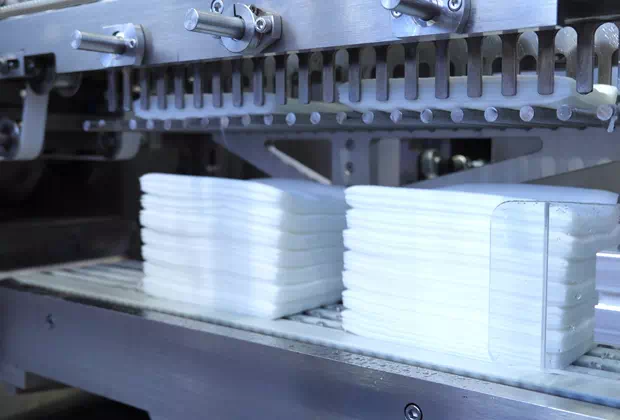
At the start of production, the non-woven fabric roll first enters the automatic unwinding system. Stable material movement is maintained through deviation correction and tension control. Then, it is cut and folded according to the finished product size. Some wet wipe production lines use Z-folds, W-folds, etc., followed by the addition of wet wipe liquid through a spraying or impregnation system, and then fixed-length cutting, counting, and stacking are completed.
Taking a common 5-30 sheet pack of wet wipes as an example, the equipment needs to simultaneously control the folding size, single sheet length, stack quantity, and packaging bag size. Some equipment can process approximately 35-80 g/m² of non-woven fabric and achieve a packaging speed of up to approximately 90 packs/minute; however, actual output is still affected by the material, the number of sheets, and the packaging specifications.
Therefore, a wet wipes machine is not simply “turning non-woven fabric into wet wipes,” but rather a continuous material control system. Unstable unwinding tension can cause material deviation, changes in folding size will affect stacking and bagging, and uneven liquid addition will directly affect the weight and usability of the finished product.
Configure a wet wipe production line based on raw materials.
For small-sized or portable wet wipes, compact equipment integrating unrolling, folding, liquid dispensing, cutting, stacking, and packaging can be used. For example, some fully automatic portable wet wipe machines support automatic double-roll feeding, with a production speed of 800–1100 wipes/minute and a packaging speed of approximately 110 packs/minute. They are also compatible with spunlace nonwoven fabrics and some biodegradable materials.
For medium- to high-speed production, multi-roll, multi-line wet wipe production equipment can be used, with added functions such as automatic alignment, tension control, online detection, labeling, and capping. When selecting a model, the nonwoven fabric weight and width, the unfolded dimensions of the wet wipes, the folding method, the number of wipes per pack, the liquid dispensing amount, and the packaging dimensions should be determined first, followed by the equipment speed and configuration, rather than simply comparing the machine’s maximum output.