

Analysis of Raw Material and Equipment Matching for Wet Wipe Machines
The main raw materials for wet wipe machines include spunlace nonwoven fabric, wet wipe liquid, packaging film, plastic caps, and labels. The basis weight, fiber ratio, width, and absorbency of the nonwoven fabric directly affect the unwinding, folding, liquid dispensing, cutting, and packaging stability of the wet wipe machine.
Spunlace Nonwoven Fabric Determines Front-End Processing Stability
Spunlace nonwoven fabric is the most important substrate in wet wipe production. Common fibers include viscose, polyester, wood pulp, and lyocell. In actual production, wet wipe nonwoven fabric can cover a range of approximately 20–110 g/m². Different products typically select materials based on softness, absorbency, and wet strength.
After the raw materials enter the wet wipe machine, they first undergo automatic unwinding, alignment, and tension control. They then enter the folding mechanism, where Z-folds, C-folds, etc., are performed according to the finished product size. Finally, they are cut to length to form individual wet wipes. For multi-row wet wipe machines, stable multi-roll feeding and automatic receiving structures can reduce downtime when changing raw materials.
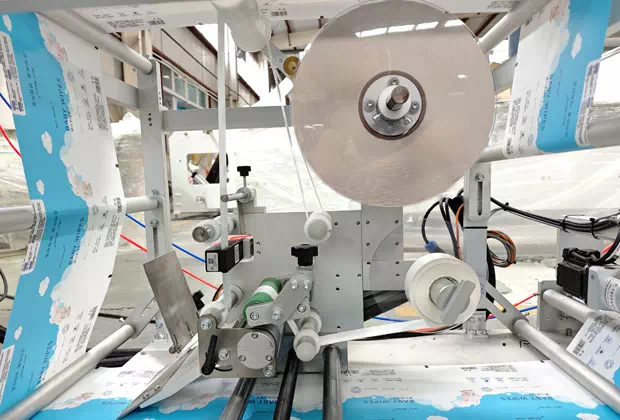
The wet wipe liquid and packaging materials need to be matched synchronously with the equipment.
Wet wipe liquid is typically composed of water and various functional ingredients, and the formulation and dosage vary from product to product. The equipment needs to be equipped with a liquid storage, filtration, metering, and dispensing system to ensure a stable distribution of the liquid onto the continuous nonwoven fabric. Higher liquid dosage is not necessarily better; excessive liquid may increase the burden on subsequent packaging and sealing.
After soaking, the wet wipes enter the cutting, counting, stacking, and packaging system. Packaging films often use heat-sealing composite materials, such as PET/PE, BOPP, or other composite structures; if the product uses pull-out packaging, a labeling machine, plastic cap installation machine, or other sealing structures are also required.
When selecting a wet wipe machine, determine the raw materials first, then the configuration.
During actual selection, it is recommended to determine in advance the nonwoven fabric weight, fiber ratio, raw material width, roll diameter, single sheet size, folding method, number of sheets per pack, liquid consumption, and packaging form. These parameters are more valuable than simply comparing “how many packs per minute”.
For example, the core differences between 6-column, 12-column, 16-column, or 20-column wet wipe production lines lie not only in the number of production columns, but also in the feeding method, automatic feeding, folding structure, liquid dispensing accuracy, and back-end packaging configuration. For production projects requiring high continuity, automatic alignment, tension control, and automatic feeding are often more important than simply increasing the theoretical speed.