

Wet Wipes and Raw Materials: From Nonwoven Fabric to Finished Product
Wet wipes are everyday hygiene products created by combining nonwoven fabric with purified water and functional liquid agents. They are manufactured through processes such as folding, precise liquid dosing, and sealed packaging. These products are widely used in areas including baby care, personal hygiene, food service, medical care, and household cleaning. The quality of wet wipes depends not only on the formulation but also on the properties of the raw materials and the precision of the production equipment.
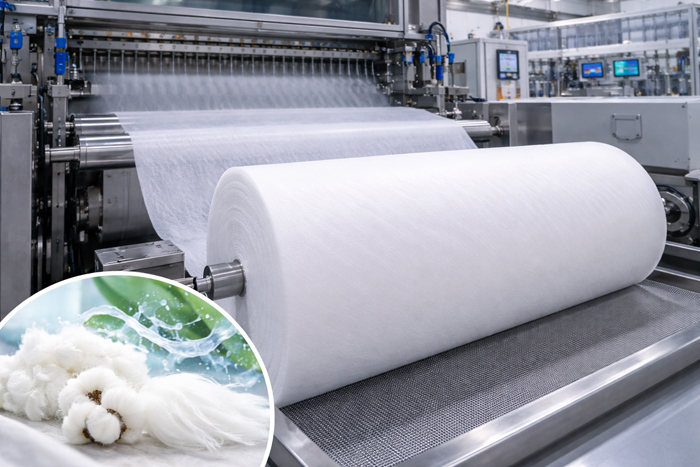
Nonwoven fabric serves as the core substrate for wet wipes. Common types include spunlace nonwovens, blends of viscose and polyester, as well as materials made from wood pulp or Lyocell fibers. These materials vary in terms of softness, liquid absorption capacity, strength, and cost. Typically, the basis weight ranges from 20 to 110 g/m², with the specific choice determined by the product’s intended use, dimensions, and packaging specifications.
The liquid solution used in wet wipes is generally based on purified water, with added moisturizers, cleansing agents, or other functional ingredients tailored to the product’s positioning. Packaging materials must offer excellent barrier properties and heat-sealing capabilities to prevent moisture loss and ensure the product remains in optimal condition for use.
Automated wet wipe production lines typically encompass several stages: unwinding of raw materials, folding of the nonwoven fabric, precise liquid dosing, cutting to specific lengths, stacking and counting, and final packaging and sealing. The equipment operates through a coordinated system of servo drives, PLC controls, and liquid metering units, ensuring that each pack meets the required specifications for sheet count, moisture content, and dimensions.
Manufacturers can configure their production lines based on the specific product type—options include machines for dual-roll or large-roll formats, portable packs, or individually wrapped (single-sheet) wipes. Multi-lane production equipment is ideal for high-volume manufacturing, while single-sheet packaging machines are better suited for sectors such as food service, aviation, and hospitality.
When selecting raw materials, it is essential to consider factors such as foldability, liquid absorption rate, material strength, and compatibility with the sealing process. Materials that are too thick may hinder folding and packaging efficiency, while insufficient liquid absorption can lead to uneven saturation. Only by appropriately matching the basis weight of the non-woven fabric, the liquid formulation, and the equipment parameters can one consistently produce wet wipe products that meet market demand.