

Raw Materials and Automated Production Equipment for Wet Wipes
The production of wet wipes requires the effective integration of substrate processing, liquid formulation, and packaging. Wet wipes designed for different applications have varying requirements regarding the softness, absorbency, and thickness of the non-woven fabric, as well as the sealing integrity of the packaging. Selecting the appropriate raw materials and matching them with suitable production equipment is crucial for ensuring both product quality and manufacturing efficiency.
Non-woven fabric is the primary raw material for wet wipes; common types include spunlace non-wovens, viscose-polyester blends, and Lyocell fibers. Spunlace non-wovens, known for their excellent softness and liquid absorption capacity, are well-suited for baby wipes, personal care wipes, and household cleaning products. The basis weight of the raw material—typically ranging from 20 to 110 g/m²—can be selected based on the product’s intended positioning, as it influences the thickness, tactile feel, and material cost of the wipes.
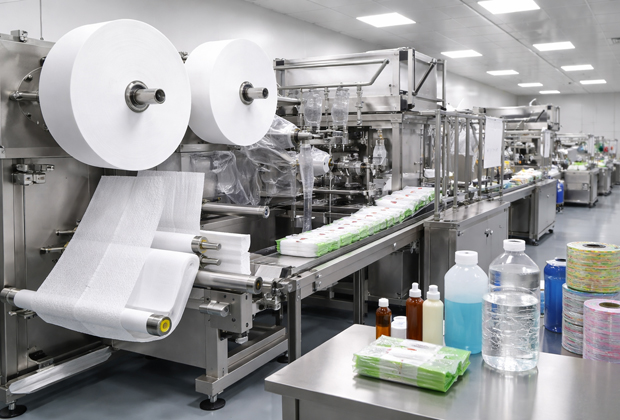
In addition to non-woven fabric, purified water, moisturizing agents, and cleaning formulations are essential components. Packaging films, labels, and plastic lids must be compatible with the dimensions and packaging format of the wipes to ensure a secure seal and minimize moisture loss during storage.
An automated wet wipe production line generally consists of an unwinding system, a folding mechanism, a precision liquid-dosing unit, a cutting mechanism, a counting and stacking system, and a packaging unit. After the non-woven fabric is continuously fed and folded, the equipment applies the liquid according to pre-set parameters, followed by cutting, stacking, and sealed packaging.
Depending on production capacity requirements, manufacturers can choose from various equipment configurations, such as dual-roll or large-roll machines, multi-lane production lines, or single-sachet packaging machines. Servo-control systems coordinate the feeding, folding, and cutting processes, helping to minimize dimensional deviations and enhance the stability of continuous operations.
In actual production, the thickness, extensibility, and liquid absorption rate of the non-woven fabric can affect equipment performance. Whenever raw materials are changed, it is necessary to re-verify parameters such as folding tension, liquid dosage, cutting length, and packaging temperature. By adjusting process parameters to mitigate issues such as material breakage, uneven stacking, and poor sealing, it is possible to improve raw material utilization and meet production requirements for wet wipes of various specifications.