

Raw Materials and Production Equipment for Wet Wipe Machines
The main raw materials for wet wipe machines include nonwoven fabric, pure water, wet wipe liquid, and packaging film. The absorbency, fiber structure, and packaging specifications of different materials directly affect the folding, liquid dispensing, cutting, and sealing effects of the equipment. Properly matching raw materials and production lines is fundamental to the stable production of different types of wet wipes.
I. Main Raw Materials for Wet Wipe Machines and Equipment Adaptation Requirements
The most commonly used substrate for wet wipe production is spunlace nonwoven fabric. Common fibers include viscose fiber, polyester, wood pulp, and lyocell fiber. The material weight can be selected according to the product application, and in practical applications, it is commonly in the range of approximately 20–110 g/m². Nonwoven fabrics with a higher viscose content generally have better absorbency and softness, while polyester helps to enhance wet strength. Different ratios will affect the feel, tensile strength, and production cost of the wet wipes.
II. How Raw Materials Enter the Wet Wipe Production Equipment
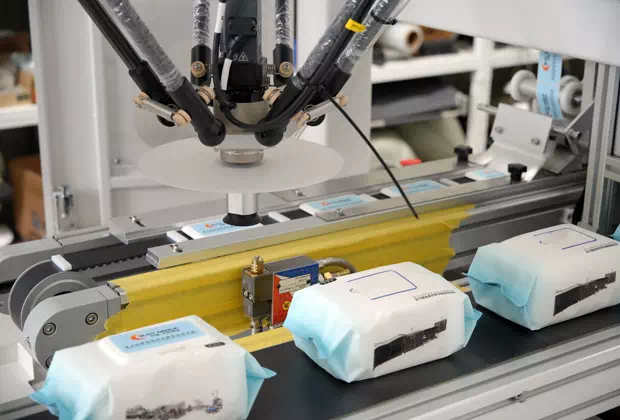
Wet wipe machines typically complete production according to the process of “unwinding—alignment—folding—liquid dispensing—cutting—counting and stacking—packaging—sealing”. Equipment configuration should be tailored to raw material specifications, rather than simply pursuing higher packaging speeds.
Non-woven fabric is first fed by an unwinding rack, with tension control maintaining stable fabric transport and a deviation correction system reducing deviation. Subsequently, a folding mechanism forms Z-folds, C-folds, or other folds according to the product design, and a cutting device divides the continuous fabric into predetermined lengths. For multi-roll parallel production lines, automatic feeding functionality can reduce downtime when changing raw materials.
III. Equipment Selection and Raw Material Parameter Matching
When selecting a wet wipes machine, the non-woven fabric weight, fiber ratio, roll width, roll diameter, unfolded wipe dimensions, number of wipes per pack, and packaging film type should be determined in advance. For example, some fully automatic wet wipes production lines are suitable for non-woven fabrics of 40–80 g/m² and can support products of 30–120 wipes per pack, depending on the configuration. The specific range still needs to be determined based on the equipment model and actual material test results.