

Raw Materials and Equipment for Wet Wipe Machines: From Nonwoven Fabric to Finished Product Packaging
The main raw materials for wet wipe machines include spunlace nonwoven fabric, wet wipe liquid, packaging film, plastic caps, and labels. The basis weight, width, absorbency, and heat-sealing performance of different materials directly affect the feeding, folding, liquid dispensing, cutting, and packaging stability of the wet wipe machine.
1. Spunlace Nonwoven Fabric Determines Front-End Processing Stability
Spunlace nonwoven fabric is one of the most widely used substrates in wet wipe production. Common fibers include viscose, polyester, wood pulp, and lyocell fibers. The basis weight range in practical applications is relatively wide; different products typically select based on softness, absorbency, wet strength, and cost. Common wet wipe materials are approximately 30–80 g/m².
After entering the wet wipe machine, the roll material first undergoes automatic unwinding, alignment, tension control, slitting, and folding before proceeding to the liquid dispensing, cutting, and packaging stages. If the material width, roll diameter, and tension stability are not matched with the equipment, misalignment, uneven folding, or material breakage can easily occur. Therefore, when selecting equipment, one should not only consider “how many packs per minute,” but also determine in advance the raw material weight, roll width, wipe size, and folding method.
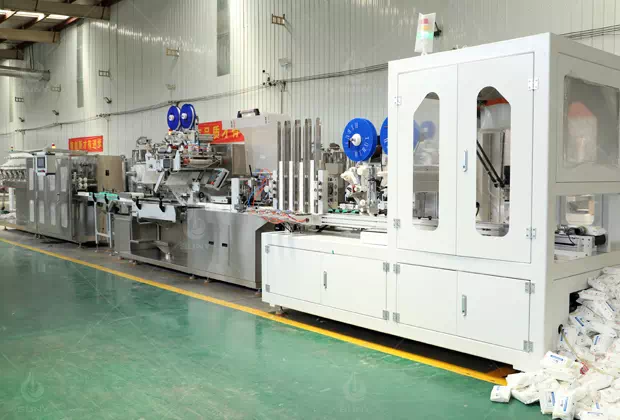
6 Line Fully Auto Wet Wipes Machine
For example, SUNY’s 6-line fully automatic wipe production line is compatible with spunlace nonwoven fabrics, washable materials, and biodegradable materials; the 12-line equipment uses a multi-roll feeding and automatic receiving structure to reduce downtime when changing raw materials.
2. Wet wipe liquid and packaging materials need to be matched synchronously with the equipment.
Wet wipe liquid is not simply “adding water.” Different products use different formulas and dosages. Therefore, the equipment needs to be equipped with a liquid storage, filtration, metering, and online liquid dosing system to ensure that the liquid content of each wipe is as stable as possible. On a high-speed production line, if the liquid dosing fluctuates, it will ultimately manifest as wipes that are too dry, too wet, or even uneven liquid distribution inside the packaging.
Packaging materials also affect machine operation. Common materials include PET/PE, BOPP, PET/AL/PE, and other heat-sealable composite films. The equipment needs to adjust the bag-making and sealing parameters according to the film width, thickness, and heat-sealing performance. Some wet wipe packaging requires additional labeling machines, plastic cap laminating machines, or automatic sealing systems to complete opening protection and secondary sealing. The packaging film width of this equipment can reach approximately 420 mm.
3. Wet wipe machines should be configured according to the “raw materials—products—capacity” principle.
A complete wet wipe production line typically consists of an unwinding system, folding machine, liquid dispensing system, cutting mechanism, counting and stacking system, packaging machine, sealing machine, and labeling/capping equipment. More automated production lines can further connect to boxing and palletizing equipment.
In actual selection, a more reasonable order is to first determine the type and specifications of raw materials → wet wipe size and number of wipes per pack → packaging form → target capacity → equipment configuration. For example, the folding section of some equipment can reach approximately 4000–4800 wipes/minute, but the final packaging speed will also be affected by the number of wipes per pack, the packaging film, and product specifications. Capacity cannot be simply judged by a single “maximum speed.”
Therefore, the raw materials and equipment of a wet wipe machine are actually an integrated whole. Stable raw materials are essential for continuous operation of unwinding, folding, liquid addition, and packaging; matching equipment parameters with raw materials is crucial to truly converting designed capacity into stable actual output.