

How Wet Wipes Machinery Controls Precision in Raw Materials?
Producing high-quality wet wipes depends not only on the proportions of raw materials such as nonwoven fabric, but also on the precise control and processing accuracy of the machinery over the material’s physical properties.
Equipment Control of Nonwoven Fabric Tension and Slicing Precision
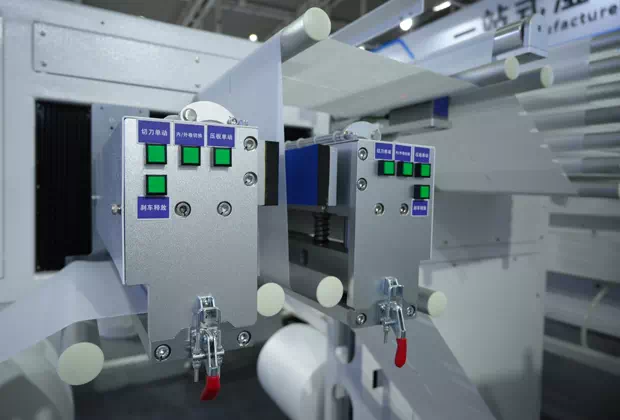
The main material of wet wipes is typically spunlace nonwoven fabric, with a basis weight mostly between 40 g/m² and 80 g/m². On automated production lines, tension control of the nonwoven fabric is crucial. If tension fluctuations exceed ±2N, it can easily lead to stretching and deformation of the nonwoven fabric, affecting the finished product’s dimensions and porosity. Modern high-precision wet wipe folding machines employ a multi-axis servo control system, combined with magnetic powder brakes or full servo tension sensors, to minimize tension errors from unwinding to folding. In the slicing stage, high-hardness alloy circular blades cut at a frequency of 600 to 800 times per minute, controlling the cut smoothness to within 0.1 mm, effectively preventing air leakage problems in subsequent packaging caused by burrs on the fabric edges.
Technical Analysis of Liquid Level Proportioning and Quantitative Spraying Systems
The liquid in the raw materials for wet wipes (typically containing over 98% EDI pure water and trace amounts of preservatives and humectants) needs to be evenly penetrated into the nonwoven fabric using quantitative spraying equipment. Traditional soaking-style liquid addition easily results in uneven liquid content, with the top dry and the bottom wet. Modern fluid metering liquid addition systems, using high-precision gear pumps and flow meters, can precisely set the liquid content between 2.5 and 3.5 times the weight of the nonwoven fabric itself, with an addition error of less than ±1.5%. Multi-point microporous spray nozzles allow the liquid to evenly penetrate multiple layers of folded fabric within 0.5 seconds, ensuring a highly consistent moisture content in each wet wipe, fundamentally solving the industry pain points of uneven liquid sedimentation and distribution.
The performance of wet wipe raw materials depends entirely on the process precision of the processing equipment. From nonwoven fabric tension to quantitative spraying, high-precision automated equipment is the core key to determining the consistency of finished product quality and production efficiency.