

Nonwoven Wet Wipe Production Machine
The core function of raw material processing equipment for wet wipes is to stably integrate various fiber substrates with liquid application systems to produce wet wipe base material at scale. This ensures the softness, absorbency, and structural consistency of the finished product while directly influencing the production line’s speed and yield rate.
Raw Material Systems and Equipment Compatibility
Raw materials for wet wipe production primarily include spunlace nonwovens, thermal-bonded nonwovens, or wood pulp composites, with spunlace nonwovens accounting for over 70% of industrial applications. Basis weights typically range from 35 to 80 gsm, with distinct requirements for fiber density depending on the intended use (e.g., baby wipes, disinfecting wipes, or flushable moist toilet tissue).
Regarding equipment, the raw material processing system typically comprises an unwinding unit, a tension control system, a web guiding (alignment) device, and an in-line material accumulator. Tension control precision generally needs to be maintained within ±2% to prevent folding misalignment or defective packaging seals.
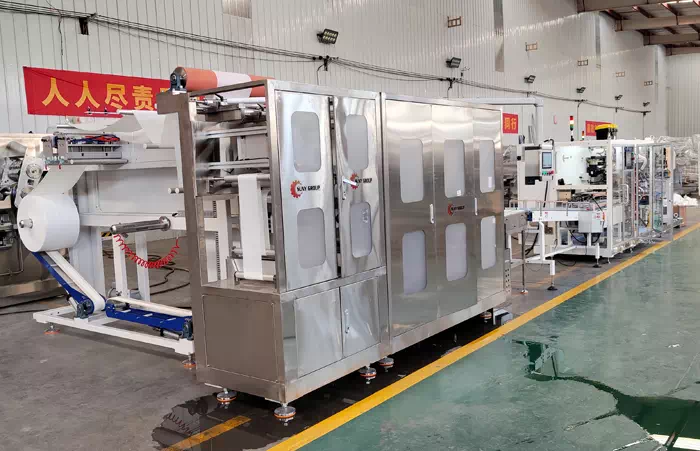
Nonwoven Wet Wipe Production Machine
Core Processing Equipment and Process Flow
Upon entering the production line, raw materials are continuously fed via an automatic unwinding system. Servo-drive controls ensure a stable operating speed within the standard industrial range of 80–120 m/min. The material then enters the wetting and liquid application system; here, metering pumps precisely control the amount of liquid added—typically 180%–300% of the fabric weight—with the saturation level adjusted according to the product type.
The folding module is a critical component, featuring configurations such as Z-fold, C-fold, or cross-fold mechanisms; its precision directly impacts the stability of single-sheet dispensing. Modern high-speed wet wipe machines typically employ multi-axis servo folding systems, keeping folding errors within ±1–2 mm. Finally, the material passes through cutting and stacking modules to provide standardized sheets for the packaging machine.
Stability Control and Industrial Value
In industrial practice, the stability of wet wipe machinery depends on three key factors: raw material tension consistency, uniformity of liquid application, and synchronization precision during folding. For mid-to-high-end production lines, the overall defect rate can be kept below 1.5%, with a daily production capacity ranging from 100,000 to 500,000 packs (depending on specifications). Furthermore, the modular design of production equipment is becoming increasingly prominent, enabling compatibility with various substrate types—such as switching from standard baby wipes to alcohol-based disinfecting wipes. This transition requires only adjustments to tension and liquid application parameters rather than a complete line shutdown and reconfiguration, a capability that is particularly critical for factories managing multiple SKUs.