

Wet Wipes Raw Materials and Manufacturing Equipment
Wet wipes manufacturing requires suitable raw materials and a properly configured production line. From nonwoven fabric and purified water to liquid formulations and packaging films, each material affects product quality, machine performance, and production efficiency.
1. Key Raw Materials for Wet Wipes Production
Nonwoven fabric is the main substrate used in wet wipes. Common options include spunlace nonwoven made from viscose, polyester, or a blend of both. Wood pulp and lyocell fibers are also used in specific applications. The choice depends on the required softness, absorbency, strength, and cost.
For conventional spunlace nonwoven, typical basis weights range from 20 to 110 gsm. Lightweight materials are suitable for many everyday cleaning wipes, while heavier fabrics are often selected for thicker household or industrial wipes.
Water is another essential component. Purified or treated water is commonly used to prepare the wetting solution. Depending on the product, the formulation may contain moisturizers, preservatives, cleansing agents, or other functional ingredients. Packaging materials, including laminated plastic films and resealable lids, also need to match the product format and sealing requirements.
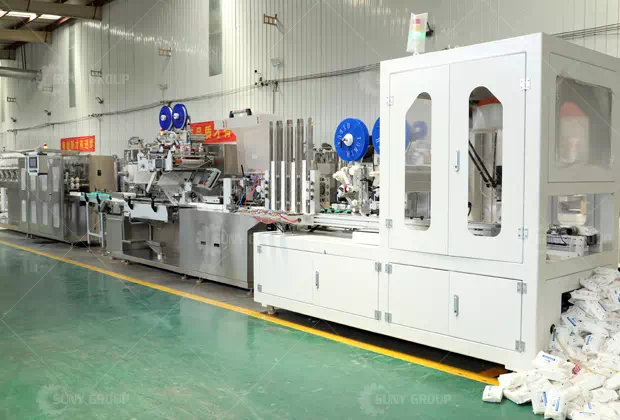
2. How Wet Wipes Machines Process Raw Materials
A wet wipes production line converts jumbo nonwoven rolls into finished, packaged products through several coordinated operations.
First, the automatic unwinding system feeds the nonwoven fabric into the machine. A tension-control mechanism helps maintain stable material delivery and reduces wrinkles or uneven feeding. The fabric then passes through the folding unit, where it is folded into the required format, such as Z-fold, C-fold, or interfold.
Next, a precision liquid dosing system applies the wetting solution evenly across the fabric. Accurate dosing is important because insufficient liquid affects moisture performance, while excessive liquid may cause leakage or packaging difficulties.
The cutting and stacking units then control sheet length and pack count. Depending on the machine design, finished stacks are transferred to individual sachet, travel-pack, or multi-piece packaging systems. Automatic sealing ensures consistent package closure and helps prevent moisture loss during storage.
3. Matching Materials with the Right Equipment
Different wet wipes products require different machine configurations. Baby wipes, household cleaning wipes, personal care wipes, and alcohol wipes may vary in fabric weight, sheet dimensions, liquid formulation, and packaging style.
Before selecting a wet wipes machine, manufacturers should confirm the nonwoven width, basis weight, folding pattern, sheet size, pieces per pack, and target production speed. These parameters directly influence the unwinding, folding, dosing, cutting, and packaging systems.
Matching raw materials with the correct equipment configuration helps maintain consistent product quality and reduces unnecessary material waste during production. A well-designed wet wipes manufacturing line should be selected according to the actual product specifications rather than machine speed alone.