

Raw Materials and Production Equipment for Wet Wipes
The raw materials used for wet wipes determine their absorbency, softness, and overall performance, while production equipment processes non-woven fabrics into finished wet wipes through a series of steps—including unwinding, folding, cutting to specific lengths, liquid application, and packaging. Properly matching raw materials with the right equipment is key to ensuring both production efficiency and product quality.
1. Common Raw Materials for Wet Wipes
The primary substrate for wet wipes is spunlace non-woven fabric, typically with a basis weight ranging from 20 to 110 g/m², depending on the intended application. Viscose fibers offer excellent absorbency and softness, while polyester fibers enhance material strength. Wood pulp and Lyocell fibers can also be incorporated to achieve specific performance characteristics.
In addition to the non-woven fabric, production requires purified water, humectants, preservative systems, and other liquid formulations. The thickness, extensibility, and absorbency of these raw materials directly influence subsequent processes such as folding, conveying, and liquid application.
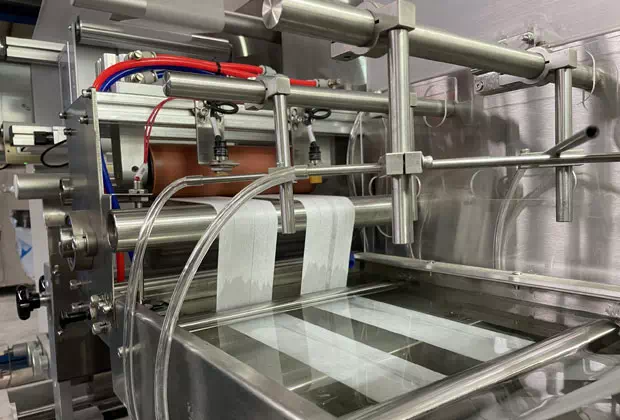
2. Matching Production Equipment with Raw Materials
A wet wipe production line generally consists of a non-woven fabric unwinding unit, an automatic folding mechanism, a cutting system, a liquid application system, and a packaging unit. The equipment unwinds the non-woven fabric rolls, folds the material into the desired dimensions, and then cuts and stacks the wipes according to the required count per package.
An automated liquid application system uses metering pumps to control the amount of liquid added, ensuring consistent moisture levels across every package. For non-woven fabrics with varying basis weights and absorption capacities, liquid application parameters must be adjusted to prevent uneven distribution or leakage after packaging.
3. Key Considerations for Optimizing Raw Materials and Equipment
Wet wipe production involves more than just focusing on machine speed. Variations in non-woven fabric thickness can lead to folding inaccuracies, while unstable material tension often causes the web to drift off-course. Furthermore, the viscosity of the liquid and the amount applied can also affect equipment operation. Consequently, tests regarding unwinding tension, folding dimensions, cutting positions, and liquid application volume should be conducted prior to full-scale production.
Selecting appropriate raw materials and configuring the wet wipe production line according to specific product requirements are essential to ensuring processing stability, high material utilization, and consistent finished-product quality.