

Wet Wipe Manufacturing Machinery and Raw Materials
Wet wipe manufacturing equipment consists of automated machinery that processes non-woven fabric raw materials through a series of stages—unwinding, folding, cutting to specific lengths, liquid application, and packaging—to produce finished wet wipes. The choice of raw materials and the configuration of the equipment are interdependent; both directly influence the absorbency, softness, production speed, and overall quality of the finished product.
Common Raw Materials for Wet Wipe Production
The primary substrate for wet wipes is spunlace non-woven fabric, typically with a basis weight ranging from 20 to 110 g/m². Raw materials include viscose fibers, polyester, wood pulp fibers, and Lyocell. Different fiber combinations affect the fabric’s softness, water absorbency, and wet strength. For instance, viscose fibers offer excellent liquid absorption, polyester enhances material strength, and wood pulp fibers are frequently used in specialized cleaning products.
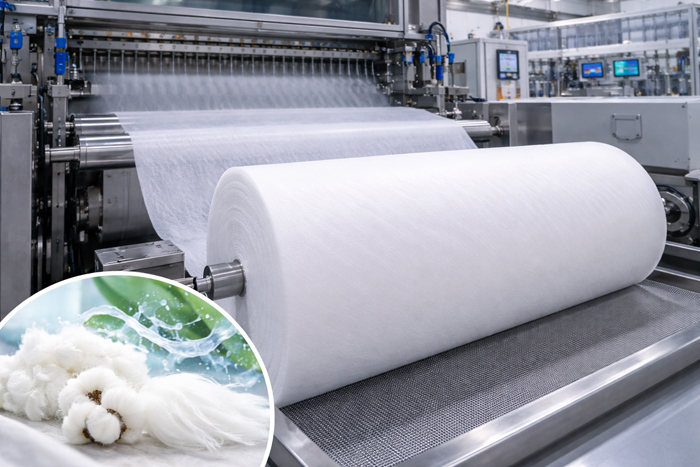
A complete wet wipe production line typically comprises a non-woven fabric unwinding stand, an automatic folding mechanism, a cutting unit, a liquid application system, a conveyor system, and an automatic packaging machine.
During production, the non-woven fabric passes through an unwinding and tension-control system before entering a series of folding rollers, where it undergoes longitudinal or interfolded processing. It is then cut to the required dimensions. Subsequently, the liquid application system—utilizing metering pumps or precision spraying devices—controls the amount of liquid added, ensuring a consistent moisture content in each wipe.
Key Considerations for Equipment Selection
In wet wipe manufacturing, higher speed is not necessarily better. Equipment selection should be based on factors such as product specifications, the number of wipes per pack, the basis weight of the non-woven fabric, target production capacity, and the desired packaging format. Multi-lane production lines are well-suited for high-volume, continuous manufacturing, whereas equipment designed for individual-pack wipes is better suited for the food service, hospitality, and airline supply markets.
During the commissioning phase, it is essential to verify the consistency of folding dimensions, the precision of liquid dosing, the tension of the packaging film, and the heat-sealing temperature. Only when the raw material characteristics, mechanical design, and process parameters are well-aligned can issues such as fabric breakage, liquid leakage, and defective seals be minimized.