

Wet Wipes Manufacturing Process and Raw Material Requirements
Wet wipe production equipment consists of automated machinery that processes base materials—such as non-woven fabrics—through a series of stages, including unwinding, folding, cutting to specific lengths, liquid application, counting, and packaging, to create wet wipes of various specifications. The basis weight, fiber structure, liquid absorption capacity, and softness of the raw materials directly influence the equipment’s operating speed, folding precision, and the quality of the final product.
Spunlace non-woven fabric is the primary raw material used in wet wipe production; the specific fiber composition and basis weight are selected based on the intended application of the product. Common materials include viscose, polyester, wood pulp, and Lyocell fibers, with basis weights typically ranging from 20 to 110 g/m².
In practical production, material selection cannot be based solely on basis weight. Factors such as fiber length, tensile strength (in both machine and cross directions), thickness, and extensibility when wet also affect unwinding tension and folding stability.
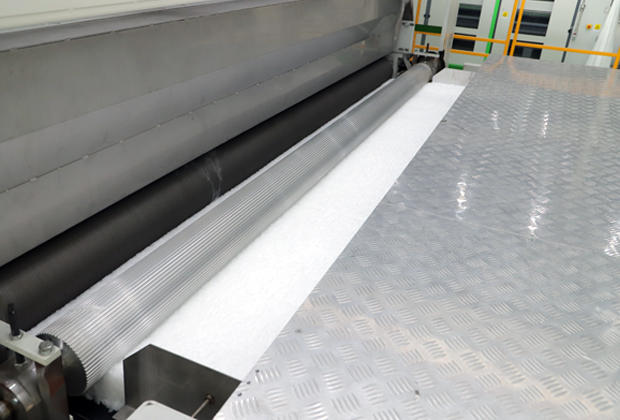
A complete wet wipe production line typically comprises a raw material unwinding system, a tension control unit, a folding mechanism, a cutting system, an automated liquid application system, a counting and conveying mechanism, and a packaging unit.
First, the unwinding unit feeds the large rolls of non-woven fabric into the production area. A servo-control system regulates the material tension based on the set operating speed, minimizing issues like misalignment or wrinkling.
Next, the folding mechanism performs longitudinal or interfolded (staggered) folding according to the product specifications. Standard wet wipe equipment can produce various formats, including single-pack wipes, portable packs (containing 5–30 wipes), or multi-roll configurations (such as 12- or 16-roll packs).
The liquid application system uses precision pumps or metering devices to distribute the prepared solution evenly across the non-woven fabric. The amount of liquid applied must be adjusted based on the material’s basis weight, absorption capacity, and the number of wipes per package. Excessive liquid can lead to package leakage, while insufficient liquid may negatively affect the user experience.
Finally, the equipment performs cutting to length, quantity control, packaging, and sealing. For high-speed production lines, factors such as unwinding tension, folding synchronization, and the precision of liquid application are critical to ensuring smooth, continuous operation.
When selecting wet wipe production equipment, it is essential to consider both the characteristics of the raw materials and the specifications of the intended final products. For instance, when producing 6–8 count mini-packs of wet wipes, one might opt for compact, high-speed packaging equipment; conversely, for 20–120 count household-sized packs, the equipment must support multi-roll unwinding, continuous folding, and automated packaging.
For 12-, 16-, or 20-lane wet wipe production lines, key considerations include synchronized multi-roll unwinding, automatic material splicing, servo control, and fault detection capabilities.