

Wet Wipes Machine Raw Materials and Equipment Selection
The main raw materials for wet wipe machines include spunlace nonwoven fabric, wet wipe liquid, packaging film, and plastic caps. Their specifications directly affect the unwinding, folding, quantitative liquid dispensing, cutting, and packaging effects of the equipment. Properly matching raw materials with the automated wet wipe production line is key to reducing material waste, stabilizing product quality, and improving continuous production efficiency.
Spunlace nonwoven fabric is the main substrate for wet wipe production, with a common basis weight of approximately 20–110 g/m². The actual selection needs to be determined based on the product’s intended use. Viscose fiber has good absorbency and softness, while polyester fiber helps improve wet strength; different fiber ratios affect the material’s processing performance.
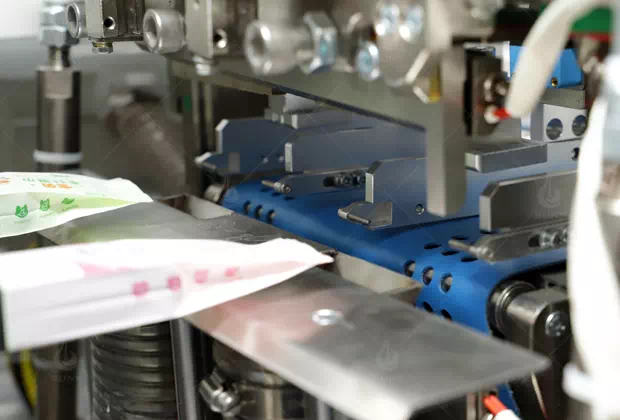
After the nonwoven fabric roll enters the wet wipe machine, it sequentially undergoes automatic unwinding, alignment, tension control, folding, and fixed-length cutting. If the roll width does not match the equipment’s feed size, problems such as misalignment and uneven folding can easily occur; unstable tension may lead to material stretching or even fabric breakage. Multi-stage wet wipe production lines also need to pay attention to the synchronous feeding of each roll to avoid affecting the overall machine operation due to abnormal feeding in a single stage.
Liquid wipes typically require storage, filtration, and metering before being evenly applied to the nonwoven fabric by an online dispensing system. The equipment can be configured with metering pumps or spray devices depending on product requirements. More liquid is not necessarily better; uneven distribution can cause localized over-wetting or under-wetting, and may also increase the difficulty of subsequent sealing.
Packaging often uses heat-sealing composite films, such as PET/PE and BOPP/PE. The wet wipe machine needs to adjust bag-making and sealing parameters according to the film width, thickness, and heat-sealing characteristics. For pull-out wet wipes, labeling machines and plastic capping machines can also be added, and some production lines can be further connected to automatic boxing equipment.
When purchasing a wet wipe machine, the nonwoven fabric weight, roll width, unfolded wipe dimensions, folding method, number of wipes per pack, and packaging format should be determined first, and then the appropriate equipment model should be selected. The common production process includes unwinding, folding, dispensing, cutting, counting and stacking, and automatic packaging.
For portable wet wipes of 5–30 wipes, a small, fully automated machine integrating folding and packaging functions can be selected; for larger packages of 60, 90, or 120 wipes, it is necessary to focus on evaluating multiple feeding stages, stacking capacity, and packaging speed. Actual production capacity will also be affected by material characteristics, the number of wipes per pack, and roll change frequency, so one cannot only look at the machine’s rated speed.