

Spunlace Nonwoven Fabric for Wet Wipes Production
Spunlace non-woven fabric is one of the most critical raw materials in wet wipe production; it directly determines the finished product’s tactile feel, absorbency, and overall user experience.
I. What is Spunlace Non-woven Fabric?
Spunlace non-woven fabric is a type of non-woven material formed by repeatedly impacting a fiber web with high-pressure, fine water jets, causing the fibers to entangle with one another. Compared to traditional woven fabrics, it does not rely on spinning and weaving processes, resulting in a shorter production cycle while yielding a structure that is notably softer and finer. Precisely because of these process characteristics, spunlace fabric retains the natural attributes of the fibers while simultaneously possessing excellent strength and uniformity.
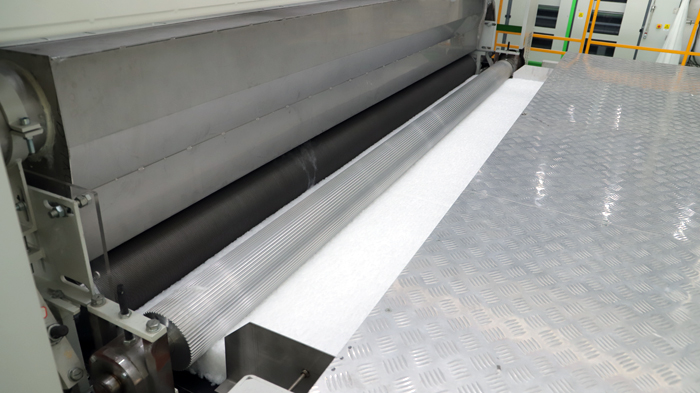
II. Why Are Spunlace Fabrics Essential for Wet Wipes?
The material requirements for wet wipes are very specific: they must be both soft and skin-friendly, while also possessing sufficient tensile strength and liquid absorption capacity. Spunlace non-woven fabric strikes an ideal balance across these three criteria. First, its fine surface texture minimizes skin irritation, making it suitable for high-standard products such as baby wipes and makeup remover wipes. Second, its entangled fiber structure allows it to retain its strength even when wet, preventing it from tearing easily. Finally, its excellent absorbency enables it to uniformly lock in liquid, thereby avoiding issues related to uneven moisture distribution. These inherent characteristics have established it as the virtually standard material within the wet wipe industry.
III. Impact on Equipment and Production
The quality of spunlace non-woven fabric directly influences the operational stability of wet wipe manufacturing machinery. If the fabric’s basis weight is inconsistent or its tension is unstable, it can easily lead to misalignment or material jams during the folding, cutting, and packaging stages. Consequently, high-quality spunlace fabric serves not only as a guarantee of product quality but also as a means of “reducing stress” on the equipment. For manufacturing enterprises, prioritizing a stable supply of raw materials is far more critical than blindly chasing the lowest price, as it ultimately determines the overall efficiency of the production line and the yield rate of finished products.
Fundamentally, competition within the wet wipe industry is not merely a contest of machinery; it is, more importantly, a competition regarding the optimal synergy between materials and manufacturing processes—and spunlace non-woven fabric constitutes a pivotal link within this entire ecosystem.