

Spunbonded Nonwoven Fabric: An Essential Raw Material for Wet Wipes Machines
Spunlace nonwoven fabric is one of the primary substrates used in wet wipes production. It is formed by entangling fibers with high-pressure water jets, providing softness, liquid absorption, and wet strength. Its basis weight, fiber composition, and roll dimensions directly affect the operating stability of the wet wipes machine and the quality of finished wipes.
Unlike conventional tissue paper, spunlace nonwoven fabric does not mainly rely on traditional chemical adhesives to form its structure. Instead, the fibers are mechanically entangled through the hydroentanglement process, giving the material good flexibility and tensile strength. Common fibers used in wet wipes include viscose, polyester, wood pulp, and lyocell. Different fiber combinations can significantly affect liquid absorption, wet strength, softness, and overall hand feel.
According to published research and product data, spunlace nonwoven fabrics are available across a relatively wide basis-weight range, with approximately 20–110 g/m² materials used in different applications. The appropriate basis weight for wet wipes depends on the product type and intended use. For example, research on baby wipes has evaluated spunlace materials made from a 50% viscose and 50% polyester blend, focusing on properties such as basis weight, thickness, liquid absorption, and dry and wet tensile strength.
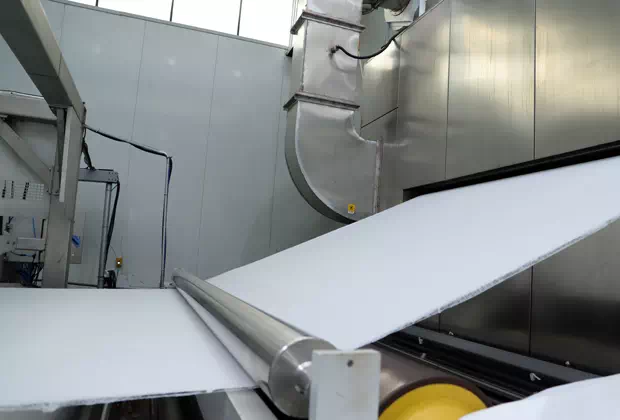
Therefore, wet wipes manufacturers should not evaluate raw materials based only on softness. Basis-weight consistency, web uniformity, absorbency, and wet tensile strength are also important factors.
Once the spunlace nonwoven fabric enters the wet wipes production line, it typically passes through several stages, including unwinding, web guiding, tension control, folding, length cutting, liquid application, counting, and packaging. For high-speed wet wipes machines, the roll width, roll diameter, material tension, and thickness variation can all affect continuous operation.
The automatic unwinding system provides a continuous supply of nonwoven fabric, while the web-guiding unit keeps the material aligned and reduces folding deviation. The folding system then forms the required single-fold or multi-fold configuration according to the product specification. After that, the cutting mechanism cuts the material to a preset length, while the liquid application system distributes the formulation evenly across the wipes. The finished wipes are then transferred to the packaging section for pouch forming, sealing, labeling, and other operations.
One factor that is often overlooked in actual production is the need to adjust machine parameters according to the characteristics of the raw material. For example, two materials with a similar basis weight of around 50 g/m² may have different tensile properties because of differences in fiber composition and hydroentanglement structure. If the unwinding tension, folding pressure, or cutting parameters remain unchanged, problems such as material breakage, web deviation, or inconsistent wipe length may occur.
When purchasing a wet wipes machine, manufacturers should not evaluate equipment performance only by its rated packs-per-minute speed. A more practical approach is to first determine the basis weight, fiber composition, roll width, wipe dimensions, and number of wipes per package, and then select the appropriate unwinding, folding, conveying, and packaging systems.
Before mass production, it is recommended to conduct continuous testing with the actual spunlace nonwoven material. Key parameters should include feeding stability, folding accuracy, liquid distribution uniformity, and finished wipe dimensions. Published studies also indicate that the performance of spunlace nonwoven fabrics is commonly evaluated through parameters such as basis weight, thickness, absorbency, air permeability, and dry and wet tensile strength.
For wet wipes manufacturers, stable raw material specifications and properly matched unwinding, folding, liquid application, and packaging equipment are the foundation of reliable production. In other words, the performance of the spunlace nonwoven fabric should be considered at the beginning of wet wipes machine selection rather than after the production line has already been installed.