

Raw Materials for Wet Wipe Machines: Matching Materials to Production Equipment
The core raw materials for wet wipe production include non-woven fabric, the wetting solution, packaging film, plastic lids, labels, and hot-melt adhesive. Properties such as material width, basis weight, liquid absorption capacity, and packaging format directly impact the stability of processes like unwinding, folding, liquid application, cutting, and sealing.
Non-Woven Fabric: The Foundation of Processing
In wet wipe production, non-woven fabric is the primary raw material that remains in contact with the equipment for the longest duration. Common substrates include spunlace non-wovens, thermal-bonded non-wovens, biodegradable non-wovens, and wet-strength paper, with spunlace non-wovens being the most widely used. Public data indicates that the typical basis weight for spunlace materials used in wet wipes ranges from 35 to 80 g/m². Fiber compositions vary from 100% polyester to 100% viscose, with ratios adjusted based on the specific product—such as baby wipes, disinfecting wipes, or general cleaning wipes.
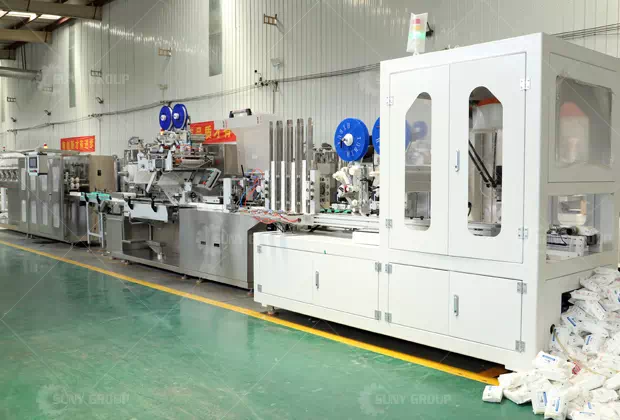
6 Line Fully Auto Wet Wipes Machine
From an equipment perspective, “thicker is not necessarily better” when it comes to raw materials. Wet wipe machines must adjust unwinding tension and folding parameters based on the fabric’s **basis weight, width, roll diameter, and tensile strength**. Taking the 6-lane fully automatic wet wipe machine from us as an example, the equipment accommodates materials such as spunlace and biodegradable non-wovens. It utilizes a multi-roll feeding and automatic splicing system to minimize downtime during material changes.
Synchronized Design for Wetting Solutions and Packaging Materials
While the non-woven fabric serves as the “carrier,” the wetting solution determines the product’s ultimate performance. Liquid formulas differ across product types—such as general cleaning wipes, baby wipes, alcohol wipes, and disinfecting wipes. Consequently, the equipment requires stable systems for **liquid storage, filtration, metering, and spraying/application** to ensure a consistent moisture level in every wipe.
Packaging materials also influence machine operation. Common packaging films feature composite structures—such as PET/PE, BOPP, or PET/AL/PE—and must offer excellent heat-sealing properties. For pop-up style wet wipes, additional equipment—such as a labeling machine, a plastic lid applicator, or a resealable closure mechanism—is required to minimize moisture loss. Technical specifications indicate that some fully automated wet wipe production lines can accommodate packaging film up to approximately 420 mm in width and support various label and plastic lid specifications.