

Raw Materials Used in Wet Wipes Manufacturing
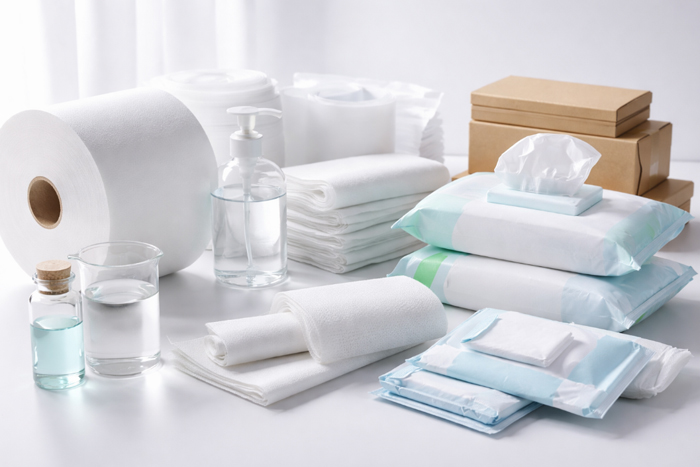
The production of wet wipes requires not only specialized machinery but also the careful selection of raw materials tailored to the intended use of the product. Common raw materials include non-woven fabrics, purified water, humectants, cleansing agents, and packaging materials. The fiber structure, liquid absorption capacity, and physical properties of these materials directly influence the softness, moisture content, tensile strength, and overall performance of the finished wet wipes. Consequently, when planning a wet wipe production line, the selection of raw materials must be aligned with both product specifications and equipment configuration.
I. Key Raw Materials for Wet Wipe Production
1. Non-woven Fabric
Non-woven fabric serves as the primary substrate for wet wipes. Common types include spunlace non-woven fabric and hot-air (through-air bonded) non-woven fabric. Spunlace fabric, created by entangling fibers using high-pressure water jets, offers excellent softness and liquid absorption; it is widely used for daily cleaning wipes, baby wipes, and personal care products.
Non-woven fabrics can be manufactured using viscose fibers, polyester fibers, or a blend of both, with other fiber materials also available depending on specific product requirements. The ratio of different fibers affects the fabric’s water absorbency, strength, and cost. When sourcing, it is also essential to consider factors such as basis weight (grammage), roll width, thickness, and material uniformity—all of which impact the feeding, folding, and cutting processes within the wet wipe production machinery.
2. Liquid Formulation for Wet Wipes
The liquid component of wet wipes is typically based on purified water, supplemented with appropriate amounts of humectants, cleansing agents, skin-conditioning ingredients, and preservative systems, depending on the intended application.
Humectants, such as glycerin, enhance the smooth, lubricated feel during use, while surfactants may be incorporated into specific types of cleaning wipes. Preservative systems must be carefully designed by considering the overall product formulation, potential microbial risks, and relevant regulatory requirements. Since the formulation requirements for baby wipes, makeup-removing wipes, and disinfecting wipes differ significantly, a single, universal liquid formulation cannot be applied across all product types.
During the production process, the liquid preparation system must strictly control the order of ingredient addition, the uniformity of the mixture, and sanitary conditions. Furthermore, the liquid formulation must demonstrate good compatibility with the non-woven substrate and packaging materials to prevent issues such as phase separation, the development of unpleasant odors, or changes in product performance after the packaging has been sealed. 3. Packaging Materials
Wet wipe packaging typically utilizes composite films with moisture-barrier properties to minimize moisture loss and reduce the risk of external contamination. Common packaging formats include individual sachets, soft-pack (pull-out) dispensers, and canisters.
For soft-packaged wet wipes, the packaging film must possess appropriate flexibility, heat-sealing characteristics, and barrier performance. Factors such as the thickness of the material, its composite structure, and the specific heat-sealing parameters directly influence the integrity of the package seal. Consequently, the selection of packaging materials for wet wipes should take into account the sealing method of the packaging machinery, the operating speed, and the dimensions of the product.