

Raw Materials and Production Equipment for Wet Wipes Machines
The raw materials for wet wipes machines primarily include spunlace non-woven fabric, purified water or formulated solution, packaging film, and plastic lids. Factors such as material basis weight, dimensions, liquid absorption properties, and packaging format directly influence the machine’s material feed speed, folding precision, liquid dosage, and final packaging quality.
Spunlace Non-woven Fabric: The Core Substrate
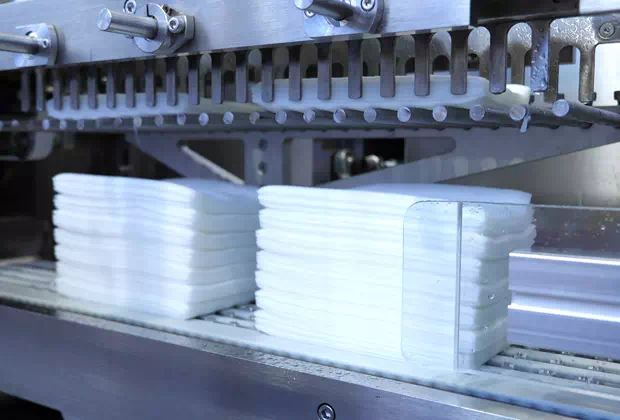
Spunlace non-woven fabric is a common substrate in wet wipes production, created by using high-pressure water jets to entangle fibers into a web-like structure. Typical basis weights range from 30 to 80 g/m², with the specific choice depending on the intended use, sheet size, and pack count.
On the production line, the non-woven fabric undergoes unwinding, web guiding, cutting to length, and folding before proceeding to the next stage. The width and diameter of the raw material rolls must match the machine’s unwinding mechanism; otherwise, issues such as misalignment, unstable tension, or folding errors may occur. Therefore, selecting a wet wipes machine requires determining raw material specifications in advance, rather than focusing solely on packaging speed.
Liquids, Packaging Film, and Auxiliary Materials
The wetting solution typically consists of water, humectants, a preservative system, and other functional ingredients. During production, the dosage is set based on sheet size and product application, with the machine controlling liquid distribution via metering pumps, sprayers, or quantitative dosing systems. Uneven dosing can result in localized areas that are too dry or too wet, making the stability of the liquid delivery system crucial.
Packaging materials primarily include composite films, plastic lids, and labels. High-speed wet wipes machines are typically equipped with units for film unwinding, bag forming, heat sealing, cutting, and lid application. For multi-pack products, the film thickness, heat-sealing temperature, and material sealing properties directly affect seal strength.
Synergy Between Raw Materials and Equipment
Wet wipes production is not merely a matter of feeding non-woven fabric into a machine; it is a continuous material processing operation. In high-speed production lines, the equipment must synchronize a series of actions—unwinding, folding, liquid application, cutting, conveying, packaging, sealing, and lid application. Variations in material parameters at any stage can impact the stability of the entire line. Therefore, when configuring a wet wipe production line, it is essential to simultaneously determine the non-woven fabric basis weight, roll dimensions, wipe specifications, pack count, film material properties, and target production capacity. Defining the raw material parameters before selecting the unwinding, folding, liquid-dosing, and packaging equipment is generally a more rational approach than simply prioritizing maximum machine speed.