The stability of raw materials and production efficiency in wet wipe manufacturing depend primarily on the coordinated control of the non-woven fabric processing system, liquid blending equipment and the automated wet wipe forming and packaging production line.
The core of wet wipe production is not merely ‘fabric and water’, but rather a complete industrial system centred on raw material processing, liquid blending, cutting and forming, and sealing and packaging. The quality of raw materials and the precision of the equipment directly determine the product’s uniformity, liquid content and user experience; therefore, the stability of production equipment is the key foundation of wet wipe manufacturing.
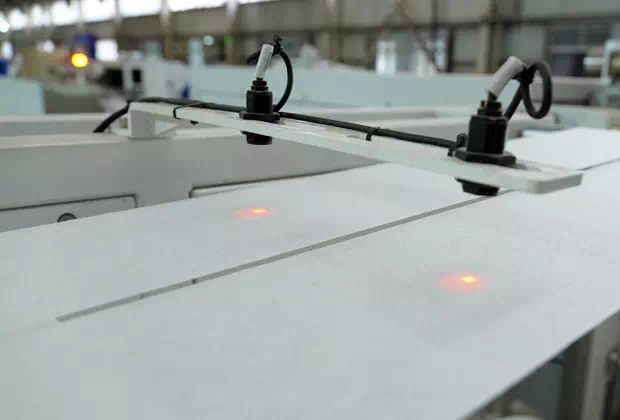
The base material for wet wipes typically consists of spunlace or thermally bonded non-woven fabric, with a basis weight generally ranging from 30 to 70 gsm. The upstream production stage involves the use of a non-woven slitting machine and an automatic feeding system to prepare and slit wide rolls of raw material, ensuring they are suitable for wet wipes of various specifications (such as 10-sheet and 80-sheet packs). Some high-end production lines are also equipped with tension control systems, which limit deviations to within ±2 per cent, thereby preventing errors in subsequent folding and cutting processes. The greater the stability of the raw material, the lower the wastage rate in the later stages; this generally reduces scrap material by 3–5 per cent.
The liquid used in wet wipes is not simply water, but a mixture of purified water, surfactants, moisturisers and preservatives blended in specific proportions. Automated liquid preparation systems typically utilise 316 stainless steel mixing tanks and precision metering pumps, with mixing ratio errors controlled to within ±1%. The liquid is then evenly sprayed or impregnated onto the non-woven fabric via a wetting device. The key control point is the liquid content ratio; for baby wipes, this is generally maintained between 180% and 250%. If too low, it affects the user experience; if too high, it creates a risk of packaging leakage.
The core of finished wipe production lies in fully automated folding and high-speed packaging systems. Equipment typically employs a 12–16-channel parallel operation configuration, capable of producing 300–800 packs per minute (depending on specifications). The folding module utilises servo control to ensure dimensional tolerances of less than 1 mm per wipe. The process then proceeds to the sealing and labelling stages, employing heat-sealing or ultrasonic sealing technology to guarantee seal strength and moisture retention. Some high-end production lines also incorporate in-line inspection systems to automatically reject packs with missing wipes or misaligned wipes.
The processing of raw materials for wet wipes is essentially an integrated system combining ‘materials engineering, fluid control and automated packaging’; fluctuations in any single stage can affect the final quality. Future industry trends are moving towards high-precision liquid dispensing systems, low-energy non-woven fabric processing and fully automated intelligent inspection.