The raw materials used for wet wipes determine the finished product’s absorbency, softness, and wet strength, while the production equipment handles the processing of nonwoven rolls—including unwinding, folding, liquid application, cutting, counting, and packaging—to consistently produce wipes of uniform specifications. Consequently, raw material properties and equipment parameters must be well-matched to minimize issues such as material breakage, misalignment, and uneven liquid distribution.
The primary raw material for wet wipes is spunlace nonwoven fabric; common fibers include viscose, polyester, and blends of the two. Viscose offers excellent absorbency and a soft feel, while polyester enhances wet strength and dimensional stability. Therefore, production processes often utilize varying fiber ratios based on specific product requirements, such as those for baby wipes, general cleaning wipes, or disinfecting wipes.
Typical basis weights for spunlace nonwoven fabrics range from 35 to 80 g/m², with the specific choice depending on wipe dimensions, folding patterns, and intended usage scenarios. In addition to the substrate, production requires liquid formulations—comprising purified water, humectants, surfactants, and preservative systems—as well as packaging films such as PE, OPP, and PET. Liquid formulations vary significantly between products; simply increasing the volume of liquid applied is not a viable method for improving moisture levels.
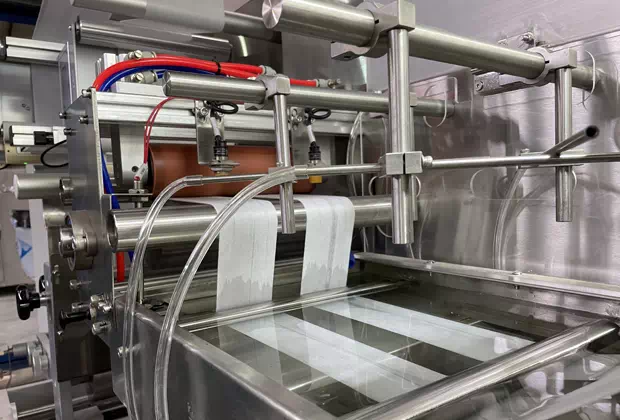
In a wet wipe production line, an unwinder continuously feeds the nonwoven fabric, maintaining stable operation through tension control and web-guiding (alignment) systems. The material then enters the folding unit, where it is shaped into Z-folds, C-folds, or other configurations as required, followed by the uniform application of liquid via spraying or dripping systems.
Once saturated, the material is processed by cutting, counting/stacking, and conveying systems to create fixed-length wipes arranged in the desired quantities. Multi-lane production lines enable simultaneous processing across multiple channels, thereby increasing output per unit of time and reducing downtime associated with frequent roll changes. Some 12-lane machines can produce packs containing between 20 and 120 wipes, supporting common specifications such as 60-count packs.
A complete wet wipe production line typically comprises a nonwoven unwinding system, a folding machine, a liquid application system, a cutting unit, a counting and stacking mechanism, a packaging machine, and equipment for applying labels or lids. Some automated production lines can also incorporate features such as in-line inspection, automatic web guiding, automatic material splicing, and finished product conveying.
In terms of equipment selection, the primary focus should not be merely on “maximum speed,” but rather on the compatibility between raw material basis weight, web width, product dimensions, sheet count per pack, liquid dosage, and packaging format. For instance, even if a machine boasts a theoretical speed of hundreds of sheets per minute, its actual effective output can still be compromised by unstable nonwoven tension or imprecise liquid application.
Therefore, wet wipe raw materials and production equipment should be designed as an integrated system, achieving continuous production—from raw nonwoven material to the finished wipe—through stable unwinding, precise folding, uniform liquid application, and reliable packaging.