Many people assume that wet wipe manufacturing is a simple process; however, what truly determines product quality is the degree of compatibility between the raw materials and the equipment used. This is particularly critical in high-speed production environments, where even slight variations in raw material properties can directly compromise equipment operational stability and the quality of the finished product.
The core raw material for wet wipes is non-woven fabric. Currently, hydro-entangled non-woven fabric is widely used in the market due to its softness and excellent liquid absorption properties, making it ideal for products such as baby wipes and personal care wipes. However, varying basis weights (grammage) and fiber structures impose different requirements on the equipment’s tension control system. If the basis weight is too low, the fabric is prone to tearing; conversely, if the resin content is too high, issues such as folding adhesion (sticking) may occur. If the equipment’s tension control system lacks stability—regardless of how high the machine’s operating speed may be—it becomes susceptible to defects such as misalignment, chain-pulling (multiple wipes dispensing at once), and poor sealing.
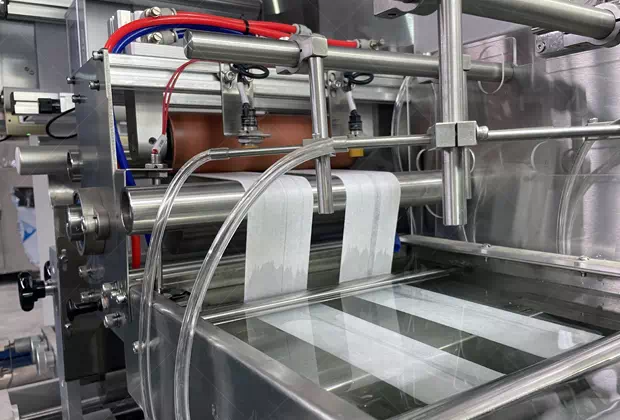
Beyond the non-woven fabric, the formulation of the wet wipe solution is equally critical. Standard cleaning wipes typically utilize a purified water-based system, whereas disinfecting wipes and personal care wipes often incorporate alcohol, antimicrobial agents, or moisturizing ingredients. The varying viscosities and volatilities of these liquids can impact the precision of the liquid filling system. Some lower-end equipment models are prone to issues such as uneven liquid distribution, leakage, or localized drying of the wipes.
Advanced wet wipe manufacturing equipment currently available on the market typically features automated web guiding (correction), precision liquid dosing, servo control systems, and inline seal integrity detection. The primary objective of these features is not merely to increase production speed, but rather to ensure stable, continuous production over extended periods. Particularly in the European and North American markets—where requirements for packaging seal integrity and hygiene standards are becoming increasingly stringent—equipment stability has emerged as a pivotal factor influencing the securing of production orders.
While the wet wipe industry may appear to have a low barrier to entry, the true competitive landscape has shifted from simply “being able to produce” to “producing with stability.” The synergistic interplay between raw material quality and equipment performance is, ultimately, the decisive factor determining both product quality and a manufacturing facility’s profitability.