Many people use wet wipes every day, yet few truly understand that behind a seemingly simple wipe lies a complex process involving multiple stages—including raw material selection, liquid formulation, automated machinery, and packaging techniques. Particularly as demand for infant care, food service cleaning, personal hygiene, and industrial wiping applications continues to grow, wet wipe production has evolved from traditional manual processing into a highly automated manufacturing industry.
The core raw material for wet wipes is non-woven fabric. Currently, common varieties found on the market include spunlace non-wovens, hot-air non-wovens, and wood pulp composite fabrics. Among these, spunlace non-wovens are widely used in baby wipes and facial cleansing wipes due to their superior softness and excellent liquid absorption capabilities. Industrial-grade wipes, conversely, prioritize abrasion resistance and tensile strength, and therefore utilize materials with a higher basis weight (grammage). Beyond the fabric itself, the liquid formulation used in the wipes is equally critical. Standard cleaning wipes typically consist primarily of purified water, supplemented with humectants, preservatives, and small amounts of functional additives; disinfectant wipes, however, require the addition of alcohol or antimicrobial agents, placing much higher demands on formulation precision and stability.
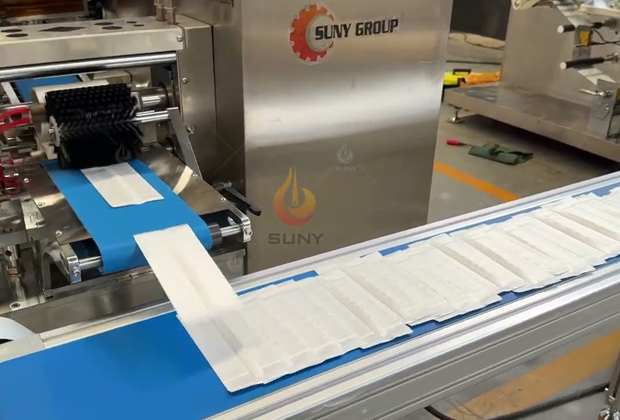
What truly determines production efficiency, however, is the wet wipe manufacturing equipment itself. Modern wet wipe machines are no longer limited to simple folding and packaging tasks; rather, they constitute a comprehensive automated system. This machinery must execute a sequence of processes, including non-woven fabric unwinding, automatic folding, precise liquid dosing, cutting, sealing, coding, and finished product output. High-speed equipment can produce hundreds of packs of wet wipes per minute, placing extremely high demands on mechanical precision and operational stability. If the equipment fails to dispense liquid uniformly, it can easily result in wipes that are either too dry or prone to leakage; similarly, unstable sealing temperatures can compromise the integrity of the packaging seal, thereby shortening the product’s shelf life.
Currently, an increasing number of manufacturers are adopting fully automated wet wipe production lines—a strategic move designed to simultaneously reduce labor costs and enhance product consistency. This trend is particularly pronounced in export markets, where clients impose stringent requirements regarding packaging dimensions, liquid content tolerances, and hygiene standards; consequently, automated machinery has become an indispensable asset for wet wipe factories seeking to bolster their competitive edge.
From the initial roll of non-woven fabric to the final packaged product, a single wet wipe is, in reality, the culmination of a sophisticated and mature manufacturing ecosystem. While raw materials establish the fundamental quality of the product, the machinery dictates the efficiency and stability of its production—two elements that are absolutely indispensable to the process. As consumers’ demands regarding safety, environmental friendliness, and user experience continue to rise, the future of wet wipes manufacturing will evolve in a direction that is more eco-friendly, intelligent, and refined.