

What are the raw materials for wet wipes?
The quality of wet wipes depends not only on the formula but also closely on the selected raw materials and production equipment. A reasonable combination of materials and a stable automated production line are key to ensuring the softness, uniform liquid content, and hygiene of the wipes.
Base Material Selection and Nonwoven Fabric Feeding System
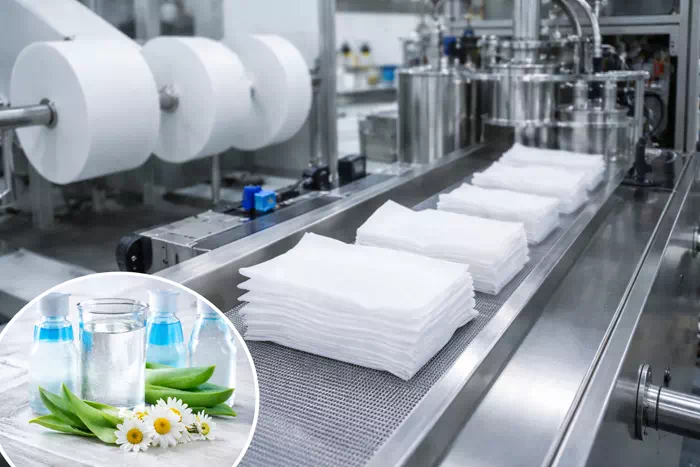
The main base material for wet wipes is nonwoven fabric, with common materials including polyester (PET), viscose fiber, wood pulp fiber, and cotton fiber. Mixing different fibers in appropriate proportions achieves a balance between strength, softness, and absorbency. Spunlace nonwoven fabric is the most widely used due to its soft touch and strong absorbency. During production, large rolls of nonwoven fabric are stably fed through an automatic unwinding and tension control system, ensuring consistent folding and cutting dimensions and providing a stable foundation for subsequent processing.
Liquid Formulation and Automatic Liquid Dispensing System
The liquid in wet wipes is typically purified water as the main component, with surfactants, humectants, preservatives, or disinfectants added depending on the intended use. To ensure uniform formulation, the production line is equipped with an automatic dispensing tank and a circulating mixing system. Using precise metering pumps and spray devices, liquid is evenly sprayed onto the non-woven fabric, ensuring a stable liquid content in each wipe and preventing over-wetness or dryness.
Integrated Molding and Packaging Production Equipment
Modern wipe production lines integrate folding, cutting, counting, stacking, packaging, and sealing into a single system, achieving fully automated operation. The equipment uses a servo control system to ensure neat folds and clean cuts, while effectively preventing moisture evaporation and secondary contamination during the sealing and packaging process. The line boasts a high degree of automation, can operate continuously and stably, significantly reducing labor costs and improving product consistency.