

Wet Wipes Raw Materials and Machine System
In wet wipe manufacturing, while the raw materials themselves are not inherently complex, the equipment’s ability to stably adapt to various materials directly determines product quality and production efficiency. A well-configured wet wipe production line can achieve continuous, high-efficiency operation—ensuring uniform liquid saturation and consistent dimensions—making it the key to boosting yield rates and reducing costs.
Non-woven Materials and Equipment Compatibility
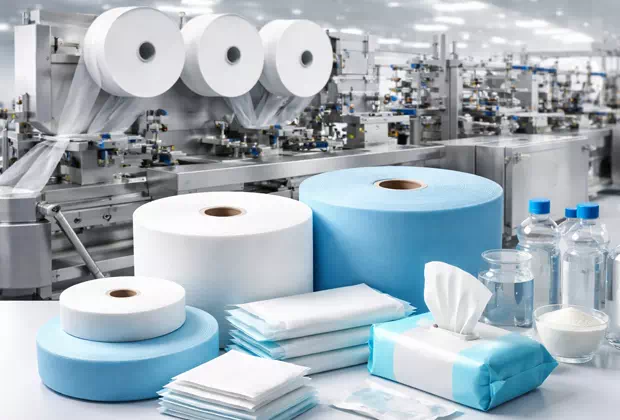
Non-woven fabric serves as the foundational material for wet wipes; common varieties include spunlace and thermal-bonded non-wovens, which vary significantly in basis weight, softness, and tensile strength. On the equipment side, adaptability primarily relies on the unwinding and tension control systems.
High-quality wet wipe machines are typically equipped with automatic tension control devices capable of dynamically adjusting operating parameters based on the fabric’s characteristics, thereby preventing stretching, deformation, or lateral deviation issues during high-speed production. Concurrently, the folding system must maintain stable precision to ensure the wipes are stacked neatly, providing consistent dimensions for subsequent packaging stages.
Liquid Systems and Dosing Control
Wet wipe formulations typically consist of purified water combined with various functional ingredients; their differing viscosities and permeabilities impose specific requirements on the equipment’s liquid dosing system.
The volumetric dosing unit within the production line must possess high-precision control capabilities to ensure that every single wet wipe contains a consistent amount of liquid. Equipment typically employs a combination of pumping and spraying mechanisms to achieve uniform saturation, complemented by anti-drip designs to prevent material waste and contamination. During high-speed operation, the stability of the liquid dosing process stands as one of the critical factors influencing overall product quality.
Packaging Materials and Whole-Line Synchronization
Wet wipe packaging materials—including composite films and plastic lids—play a decisive role in ensuring product airtightness and moisture retention. On the equipment side, an automated packaging system executes processes such as pouch forming, sealing, and lid application.
Specifically, the sealing system requires precise temperature control to guarantee strong, secure edge seals; wet wipes featuring plastic lids rely on automated lid-attachment devices to ensure accurate positioning and firm adhesion. The operational rhythm of the entire production line must remain synchronized with the upstream manufacturing stages; otherwise, issues such as material accumulation or misalignment may arise, compromising overall efficiency.
The true core of wet wipe manufacturing lies not merely in the individual materials themselves, but rather in the degree of compatibility and synergy between the equipment and those materials. Only when the non-woven fabric, liquid formulation, and packaging materials function in perfect harmony can the production line consistently deliver a stable, high-quality product output.