

The Selection of Raw Materials and the Adaptation of Wet Wipe Production Equipment
The raw materials used in wet wipes directly affect the product’s softness, absorbency, user experience, and production stability. For wet wipe manufacturers, in addition to selecting suitable nonwoven fabrics and wet wipe liquid, it is also necessary to adjust the unwinding, folding, cutting, liquid dispensing, and packaging parameters of the wet wipe machine according to the characteristics of the raw materials to ensure a stable production process.
Nonwoven fabric is the main substrate for wet wipes. Common types include spunlace nonwoven fabric, wood pulp composites, and washable nonwoven fabric. Different products have different requirements for material basis weight and fiber composition, with common basis weights ranging from approximately 20–110 g/m². For example, baby wipes typically emphasize softness and skin-friendliness, while cleaning wipes need to balance strength and absorbency.
Wet wipe liquid usually consists of water, humectants, and other formulation ingredients that meet product requirements. Its viscosity, dosage, and formulation stability affect the uniformity of liquid content in the wet wipes, therefore it needs to be matched with a metering dispensing system.
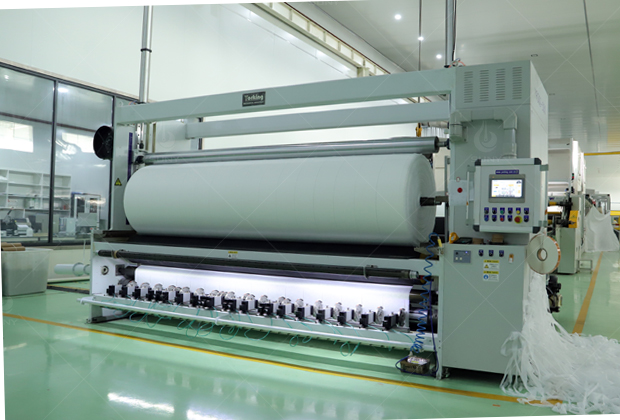
On a wet wipe production line, non-woven fabric first undergoes unwinding and tension control, then enters the folding, slitting, and quantitative liquid addition stations, finally completing stacking and packaging. If the material thickness is uneven, the strength is insufficient, or the roll tension is unstable, problems such as folding deviation, uneven cuts, and conveyor misalignment can easily occur.
For multi-row wet wipe machines, it is also necessary to pay attention to the matching of material width, fiber structure, and equipment folding method. When changing to non-woven fabrics of different weights, the feeding speed, cutting parameters, and liquid addition volume should be retested, rather than directly using the original settings.
Wet wipe packaging forms include single-sheet packs, portable packs, pull-out bags, and tubs. Different packaging specifications will affect the folding size, stacking quantity, and packaging machine configuration of the wet wipes. For example, producing wet wipes with 90 sheets per pack requires adjustments based on the number of folds, stacking mechanism, and packaging speed.
When selecting raw materials for wet wipes, product positioning, equipment compatibility, and subsequent packaging requirements should be considered simultaneously. The more properly the raw materials are matched with the wet wipe machine, the better it is to reduce problems such as material breakage, deflection, and uneven liquid content during the production process.