

The Intricate Puzzle Behind Wet Wipes: Unveiling the Raw Materials for Wet Wipe Manufacturing
In the realm of modern personal care and cleaning, a small pack of wet wipes has long since become an indispensable convenience in people’s daily lives. However, producing high-quality, safe, and reliable wet wipes—often through high-speed, automated manufacturing lines—relies entirely on an incredibly precise and rigorous combination of raw materials. These materials can be broadly categorized into three core components: the substrate, the impregnating solution, and the packaging materials.
I. The Substrate: The Carrier of Softness and Strength. The substrate serves as the structural foundation of the wet wipe—the part that comes into direct contact with the skin—and its quality directly determines the product’s tactile feel and user experience. The vast majority of wet wipes utilize non-woven fabrics, with spunlace non-wovens being the most widely applied variety. Spunlace fabrics are created by directing high-pressure, fine jets of water onto a web of one or more fiber layers, causing the fibers to entangle with one another to form a structure that is both strong and soft. The raw materials for non-woven fabrics are diverse, ranging from viscose fibers (known for their excellent absorbency and skin-friendliness) and polyester fibers (which provide structural strength) to eco-friendly and sustainable options such as cotton, wood pulp, and bamboo fibers. The selection of a substrate requires carefully balancing multiple performance metrics, including absorbency, softness, tensile strength, and linting rate.
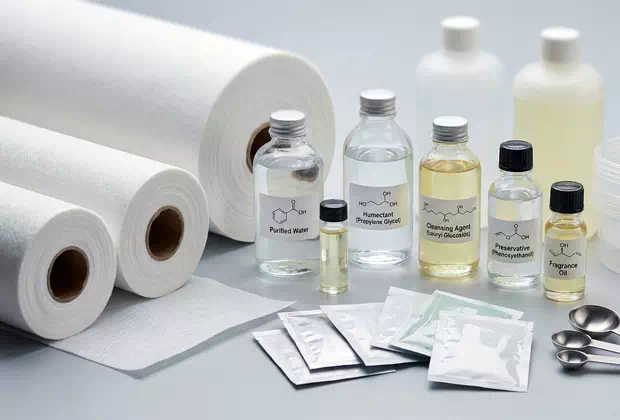
II. The Impregnating Solution: The Functional “Soul” of the Wet Wipe. The ability of a wet wipe to cleanse, moisturize, or even disinfect depends entirely on the liquid with which it is saturated. This liquid is not merely ordinary water; rather, it is a precisely formulated “impregnating solution” tailored to the specific positioning and purpose of the product. Its primary constituent is ultra-pure or deionized water that has undergone multi-stage filtration and sterilization processes. Into this purified water, various functional ingredients are added as needed:
Surfactants: Used to enhance cleaning efficacy and facilitate the removal of dirt and grease.
Humectants and Skin-Conditioning Agents: Such as glycerin, propylene glycol, aloe vera extract, and Vitamin E; these ingredients help prevent skin dryness after wiping.
pH Adjusters: Used to maintain the wet wipe’s pH level within a slightly acidic to neutral range, thereby aligning it with the natural pH balance of human skin.
Antimicrobials and Preservatives: These are critical for ensuring the hygiene and safety of the wet wipes. Since wet wipes are rich in moisture and nutrients, they are highly susceptible to bacterial growth; therefore, it is essential to incorporate low-irritation preservatives that comply with established safety standards. Fragrance: Provides a pleasant scent; however, many baby wipes and wipes designed for sensitive skin adhere to “fragrance-free” formulations.
III. Packaging Materials: The “Security Gate” of Quality. To ensure that wipes remain moist and free from contamination before reaching the consumer, their packaging materials are of paramount importance. Wipe packaging typically utilizes multi-layer composite films; common structures include PET, aluminum foil (or aluminized film), and PE. PET provides structural strength and printability, aluminum foil (or aluminized film) offers excellent barrier properties against oxygen and moisture vapor, while PE provides heat-sealability and moisture resistance. For wipes featuring a hard lid, high-quality plastic lids and easy-peel adhesive labels are also essential to ensure an effective seal that remains intact even after repeated opening and closing.
In summary, the raw materials used in wipe manufacturing are not merely a simple physical assemblage, but rather a perfect fusion of materials science and chemical formulation technology. Only when high-quality non-woven substrates, safe and effective impregnating liquid formulations, and high-barrier packaging materials work in concert—processed through precision wipe manufacturing machinery—can we produce premium products that consumers can use with complete peace of mind.