

Raw Materials and Equipment for Wet Wipes Production
In the wet wipes manufacturing industry, while many focus on product formulations and market trends, they often overlook a more fundamental issue: how equipment is matched to raw materials—a critical factor that ultimately determines both final product quality and production efficiency. Fundamentally, a wet wipes machine functions as a “material handling system”; consequently, different raw materials impose vastly different requirements on the equipment’s structural design and operational stability.
Non-woven Fabrics and Equipment Compatibility
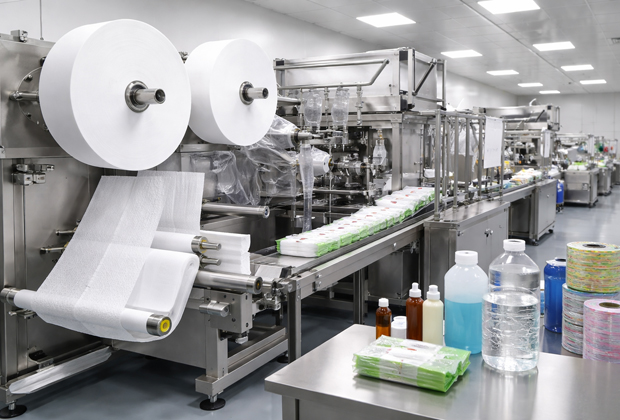
Non-woven fabric constitutes the core raw material in wet wipes production; its basis weight, softness, and tensile strength directly influence the user experience of the finished product. Common materials include spunlace non-wovens and thermal-bonded non-wovens; among these, spunlace fabric is widely utilized in baby wipes due to its exceptional softness and skin-friendly properties.
Liquid Formulations and Dosing Systems
The “soul” of a wet wipe lies in its liquid formulation, which typically consists of purified water, moisturizing agents, and antimicrobial ingredients. Wet wipes designed for different applications have varying requirements regarding liquid viscosity and permeability, thereby imposing rigorous standards on the equipment’s liquid dosing system.
Packaging Materials and Integrated Line Coordination
In terms of equipment configuration, the packaging system must be highly synchronized with the production pace of the upstream manufacturing stages—specifically the automated pouch-forming, sealing, and lid-application processes. This is particularly critical in the production of wet wipes featuring hard lids, which demands extremely high precision in lid placement; consequently, such lines typically require the integration of automated lid-applicators—or even robotic systems—to ensure that every lid is positioned accurately and securely sealed. Concurrently, the sealing system must maintain precise and stable temperature control; failure to do so can lead to issues such as weak edge seals or material deformation.
While wet wipes production may appear deceptively simple, the true key to achieving stable, reliable operation lies in the equipment’s “adaptability” to the specific raw materials being processed. Only when the non-woven fabric, liquid formulation, and packaging materials are perfectly matched with the machinery can the production line consistently deliver high-quality products.