

Key Materials Used in Wet Wipes Manufacturing Machines
The stable operation of wet wipe production equipment relies on a well-matched raw material system. Different types of wet wipes have specific requirements for the substrate, liquid formulation, and packaging materials. Only when the raw materials and equipment structure are highly compatible can production efficiency be improved while ensuring quality.
Non-woven Fabric Substrate Selection
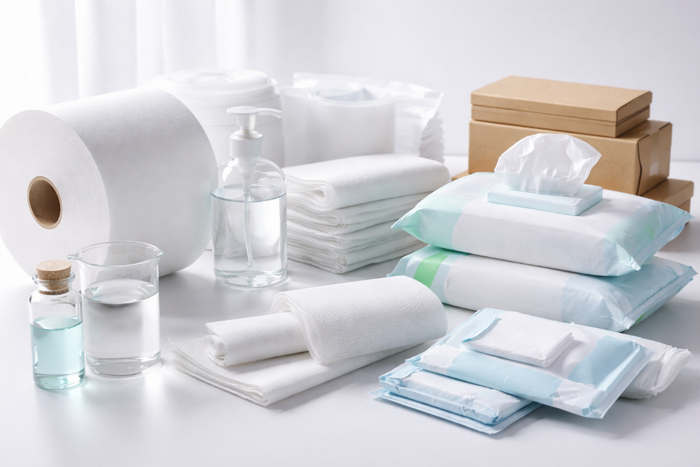
The core raw material for wet wipes is non-woven fabric, common types including spunlace non-woven fabric, hot-air non-woven fabric, and spunbond non-woven fabric. Among them, spunlace non-woven fabric is widely used in baby wipes and personal care wipes due to its soft feel, strong liquid absorption, and high strength. The basis weight, width, and fiber ratio of the substrate need to be adjusted according to the intended use of the wet wipes. High-quality non-woven fabric maintains stable tension during unwinding and folding processes, is less prone to pilling and breakage, and helps improve the overall line efficiency.
Wet Wipe Liquid Formulation
Wet wipe liquid is usually based on purified water, with moisturizers, cleaning agents, or antibacterial ingredients added depending on the product positioning. The formulations of catering wipes, alcohol disinfectant wipes, and nursing wipes differ significantly. During production, the liquid must be kept uniform through a filtration and stirring system before being precisely sprayed onto the non-woven fabric by an automatic liquid dispensing device. The quality of the liquid directly affects the moisturizing effect and user experience of the wipes, and also relates to product safety standards.
Packaging and Auxiliary Materials
Besides the fabric and liquid, packaging film is also a key material. Single wipes often use composite films for four-side sealing, while larger packages use multi-layer composite bags with plastic flaps. Packaging materials must have good sealing and moisture-proof properties to prevent moisture evaporation. At the same time, auxiliary materials such as labels and cartons must also be compatible with the automatic packaging equipment to ensure secure sealing and a neat appearance.
Wet wipe production is not only about equipment operation, but also the result of the coordinated operation of the material system. The rational selection of raw materials is an important foundation for ensuring product quality and enhancing market competitiveness.