

How to Choose Raw Materials for Wet Wipes?
In the production of wet wipes, the choice of raw materials not only determines the user experience but also directly affects the operational stability of production equipment and the quality of the finished product. For wet wipe manufacturers, rationally matching material properties with production processes is key to achieving efficient and stable production.
How to Choose Raw Materials for Wet Wipes?
Currently, most wet wipes on the market use spunlace nonwoven fabric as the base material. This type of material features uniform fiber distribution, strong absorbency, softness, and breathability, effectively absorbing cleaning liquids and improving user comfort. Different application scenarios have significantly different material requirements: daily cleaning wipes emphasize a balance between absorbency and cost; baby or personal care wipes prioritize softness and safety; industrial or kitchen cleaning requires materials with higher strength and abrasion resistance. Common fiber combinations include viscose and polyester blends, wood pulp composites, and natural materials such as cotton and bamboo fiber. In recent years, biodegradable and flushable materials have also gradually become a market trend. These materials often use wood pulp, viscose, or other natural fibers to meet environmental protection requirements.
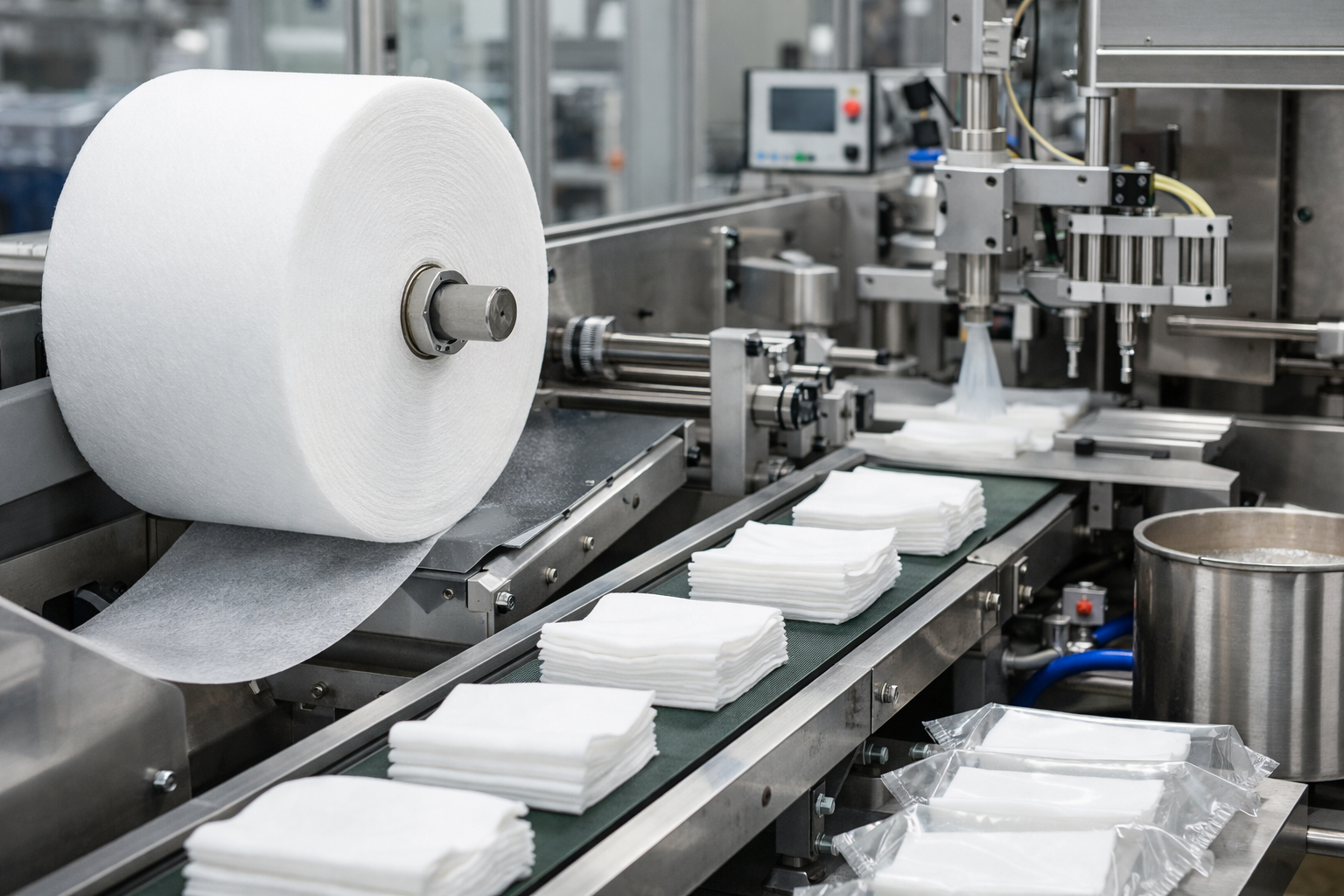
High-quality materials can only realize their maximum value when paired with suitable equipment. In actual production, spunlace nonwoven fabric typically enters automated wet wipes production lines in master roll form, where stable operation is ensured by an unwinding system, tension control device, and web guiding system. It then enters the folding and cutting unit to achieve the required specifications. Different weights and fiber ratios of materials place varying demands on equipment tension, cutting precision, and folding structures; therefore, production lines usually need adjustable parameters to accommodate diverse product needs. For highly absorbent or thick materials, the equipment also requires an efficient liquid impregnation system to ensure uniform liquid distribution and avoid uneven wetting, thereby improving product consistency and quality stability.