

How are wet wipes made?
Wet wipes may seem simple, but they are a daily necessity with extremely high requirements for materials, formulas, and processes. What truly determines product quality is not production speed, but the degree of matching of three core elements: the substrate, the wetting solution, and the packaging system. The balance between these three directly affects the user experience and market competitiveness of the wet wipes.
First is the substrate, which is the “skeleton” of the wet wipe. Currently, the industry mainstream uses non-woven fabrics, and the processes vary depending on the application. Spunlace non-woven fabrics are soft and delicate, suitable for baby and personal care products; spunbond materials have high strength and are mostly used in industrial or heavy-duty cleaning; while meltblown materials have strong liquid absorption capacity and are commonly used in disinfectant or functional wet wipes. When choosing a substrate, companies must consider not only the feel and absorbency, but also test tensile strength, basis weight, and stability to ensure reliability during production and use.
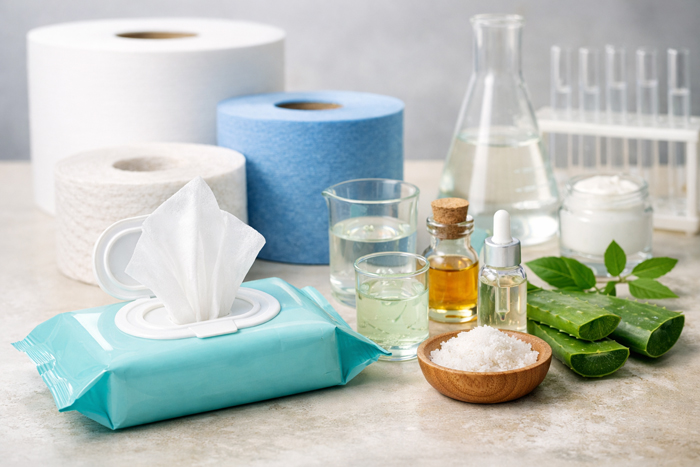
If the substrate determines the feel, then the wetting solution determines the function. Water is the main carrier, but a mature formula involves much more than that. Glycerin, aloe vera, and other moisturizing ingredients enhance comfort; humectants help lock in moisture and extend the product’s shelf life; preservatives inhibit microbial growth, ensuring safety and stability; and depending on the application, antibacterial ingredients, plant extracts, or vitamins may be added. The entire formulation process requires precise proportion control and must pass stability and safety tests.
Finally, the packaging system is often overlooked. Wet wipes are high-moisture products, and insufficient sealing will cause them to dry and become ineffective quickly. High-quality packaging not only needs good barrier properties but also a resealable design to reduce air contact. Meanwhile, portability, ease of use, and the use of environmentally friendly materials are increasingly becoming important areas of market competition.
From material selection to formulation design, and then to sealing and dispensing structures, wet wipe manufacturing is essentially a systematic project. Only by finding a balance between comfort, stability, and safety can a truly practical and marketable product be created.