Many believe wet wipes are simply “non-woven fabric and water,” but the true determinant of product quality is the matching and control of a complete system of raw materials. From the base material and water quality to the formula and packaging, every step directly impacts the wet wipe’s feel, safety, and market positioning.
Non-woven fabric is the core material of wet wipes and the first layer of user experience. Common materials include polyester fibers, viscose fibers, or a mixture of both. Higher polyester content results in better strength and durability; a higher proportion of viscose makes the wipes softer and more absorbent. In recent years, natural materials such as bamboo fiber and wood pulp have been increasingly used in mid-to-high-end products due to their environmentally friendly and skin-friendly characteristics. Different embossing techniques, such as pearl or mesh patterns, can also improve cleaning effectiveness and feel.
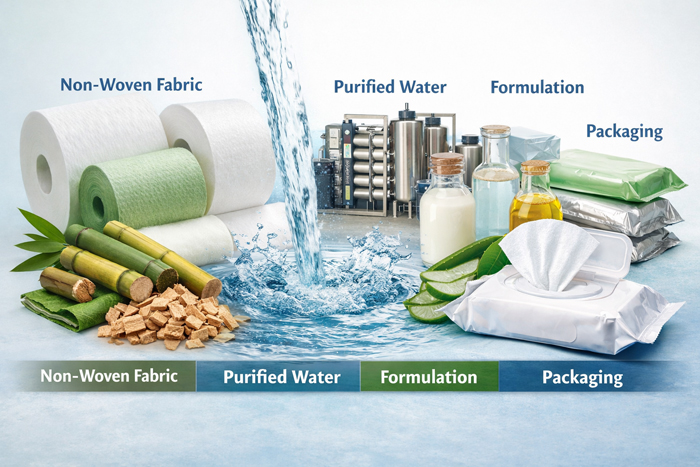
Water quality is fundamental to the safety of wet wipes. Since water typically accounts for over 90% of a wet wipe’s composition, the purity of the water directly affects product stability and microbial control. The industry commonly uses reverse osmosis (RO) systems for purification, and high-standard production also incorporates EDI technology to provide more stable, high-purity water, ensuring the product is gentle and safe, suitable for infant care or those with sensitive skin.
Based on this, appropriate formulas are added according to different uses. Baby wipes emphasize low irritation and gentle care, cleaning wipes focus on stain removal, and disinfectant wipes have antibacterial functions. Mature production systems typically support customized formulas to meet different market demands.
Furthermore, packaging is equally important. Composite film materials, flip-top structures, and sealing designs determine the wet wipe’s moisturizing effect and ease of use. With increasing environmental awareness, biodegradable and recyclable packaging materials are also becoming an industry trend.
Overall, the quality of wet wipes is not determined by any single material, but rather by the overall synergy of the base material, water treatment, formula, and packaging. Only by establishing a stable and systematic raw material system can truly safe, comfortable, and competitive products be produced.