Categories
News

How are wet wipes made?

Wet wipes may seem simple, but they are a daily necessity with extremely high requirements for materials, formulas, and processes. What truly determines product quality is not production speed, but the degree of matching of three core elements: the substrate, the wetting solution, and the packaging system. The balance between these three directly affects the user experience and market competitiveness of the wet wipes.

First is the substrate, which is the “skeleton” of the wet wipe. Currently, the industry mainstream uses non-woven fabrics, and the processes vary depending on the application. Spunlace non-woven fabrics are soft and delicate, suitable for baby and personal care products; spunbond materials have high strength and are mostly used in industrial or heavy-duty cleaning; while meltblown materials have strong liquid absorption capacity and are commonly used in disinfectant or functional wet wipes. When choosing a substrate, companies must consider not only the feel and absorbency, but also test tensile strength, basis weight, and stability to ensure reliability during production and use.
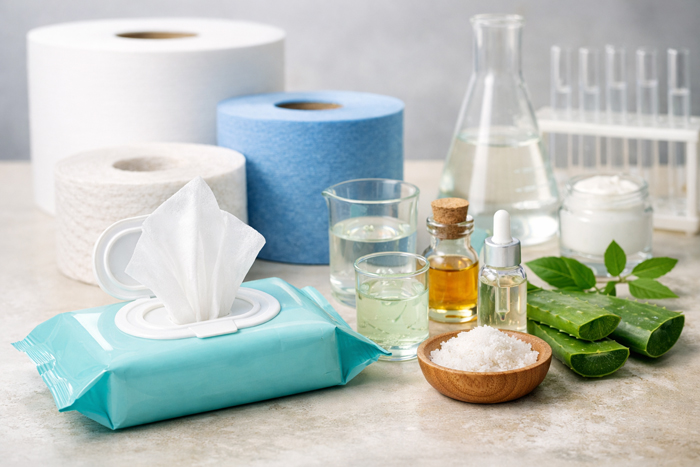
If the substrate determines the feel, then the wetting solution determines the function. Water is the main carrier, but a mature formula involves much more than that. Glycerin, aloe vera, and other moisturizing ingredients enhance comfort; humectants help lock in moisture and extend the product’s shelf life; preservatives inhibit microbial growth, ensuring safety and stability; and depending on the application, antibacterial ingredients, plant extracts, or vitamins may be added. The entire formulation process requires precise proportion control and must pass stability and safety tests.

Finally, the packaging system is often overlooked. Wet wipes are high-moisture products, and insufficient sealing will cause them to dry and become ineffective quickly. High-quality packaging not only needs good barrier properties but also a resealable design to reduce air contact. Meanwhile, portability, ease of use, and the use of environmentally friendly materials are increasingly becoming important areas of market competition.

From material selection to formulation design, and then to sealing and dispensing structures, wet wipe manufacturing is essentially a systematic project. Only by finding a balance between comfort, stability, and safety can a truly practical and marketable product be created.
Categories
News

How Are Wet Wipes Made

Wet wipes may look simple, but behind every soft, evenly moistened sheet is a highly integrated and automated manufacturing system. The real core of wet wipes production is not just the formula, but the machines that ensure consistency, hygiene, efficiency, and large-scale output. Modern wet wipes manufacturing lines are designed to run continuously, combining material handling, liquid preparation, fabric treatment, cutting, folding, packaging, and quality control into one streamlined process.

The production process begins with nonwoven fabric handling equipment. Large parent rolls of nonwoven material are loaded onto automatic unwinding systems equipped with tension control and edge correction devices. These systems ensure that the fabric moves smoothly and remains flat even at high production speeds. Wet wipes machines are typically compatible with various substrates, including spunlace, wood pulp composite, viscose blends, and synthetic nonwovens, allowing manufacturers to produce different types of wipes on the same line.

At the same time, the liquid preparation system operates independently but in coordination with the fabric line. Stainless steel mixing tanks are used to prepare the wet wipes solution, combining purified water with cleansing agents, moisturizers, preservatives, and optional fragrances. These tanks are fitted with heating, stirring, and filtration systems to ensure uniform mixing and hygienic conditions. Automated control panels manage temperature, mixing time, and ingredient ratios, ensuring stable formulation quality for every batch.

Once the solution is ready, the nonwoven fabric enters the impregnation section of the machine. Depending on the equipment design, the fabric is either fully immersed in the solution or evenly sprayed using precision nozzles. Advanced dosing systems accurately control the liquid content, ensuring each wipe has the same moisture level without dripping or drying out. This step is critical for product performance and user experience.

After impregnation, the treated fabric is guided into the cutting and folding section. High-speed rotary cutters divide the continuous fabric into individual wipes with precise dimensions. Automated folding mechanisms then stack the wipes according to the required format, such as Z-fold, C-fold, or interfold. These operations are synchronized to maintain speed and alignment, even during long production runs.

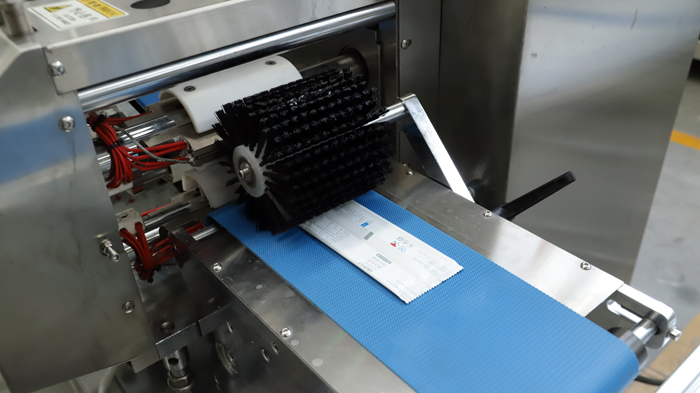
The folded wipes are then transferred to the packaging system. Depending on the product type, the machine can automatically pack wipes into flow packs, soft packs, plastic canisters, buckets, or refill pouches. Heat sealing technology ensures airtight packaging, preventing moisture loss and contamination. Many modern wet wipes machines integrate online inspection systems that monitor weight, count, seal integrity, and overall packaging quality in real time.

Finally, quality control systems play a vital role throughout the entire production process. Sensors, monitoring software, and sampling stations help detect deviations in moisture content, wipe size, or packaging integrity. Only products that meet strict standards proceed to final boxing and shipment.

In summary, wet wipes production is a machine-driven, precision-controlled process. The performance, reliability, and automation level of the manufacturing equipment directly determine the quality, efficiency, and scalability of wet wipes production, making advanced machinery the true foundation of successful wet wipes manufacturing.